
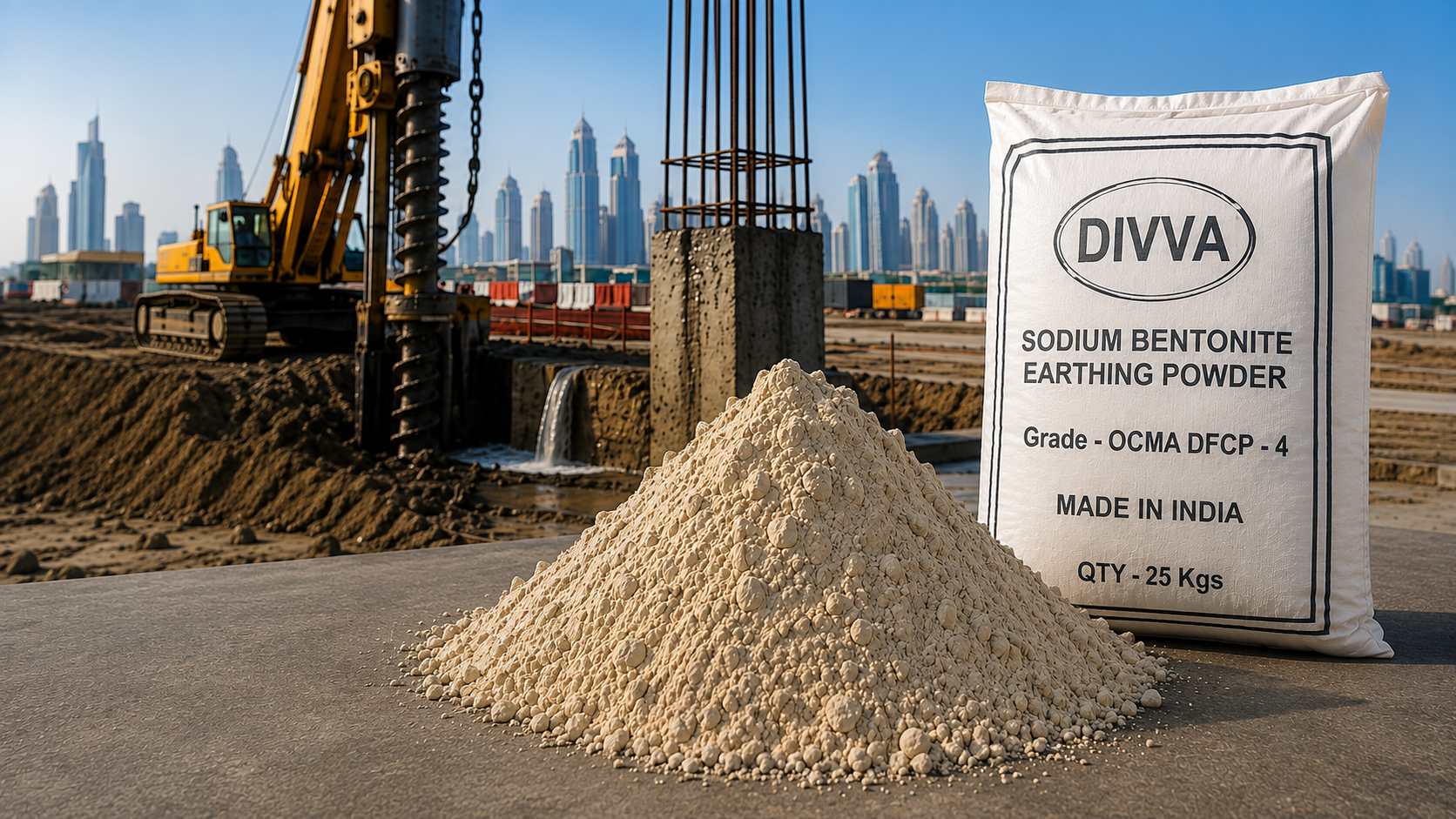
Few industrial minerals work as hard as bentonite. The same beige powder stabilises the boreholes beneath Dubai’s towers, keeps drilling bits cool in the desert, and sits packed around the earth electrodes that protect the region’s substations. Sodium bentonite — the high-swelling form of this montmorillonite clay — is the grade that matters for almost all of these jobs, and demand across the GCC is driven overwhelmingly by construction and infrastructure. This guide covers what sodium bentonite actually does, its major uses in the region, and — because the material is only as good as its certificate — how to choose a bentonite supplier you can rely on.
How sodium bentonite works
Bentonite is a clay formed from weathered volcanic ash, made up of microscopic plate-like particles of the mineral montmorillonite. What makes the sodium form special is its appetite for water: the plates pull water molecules between them and the clay swells to many times its dry volume, forming a dense, gel-like suspension. Calcium bentonite, the other common form, swells far less — which is why tenders and datasheets specify sodium bentonite for swelling-dependent applications.
That swelling gel does three useful things at once. It thickens water into a fluid that can carry solid particles. It plasters onto porous surfaces and seals them against water movement. And it holds onto its moisture stubbornly, resisting drying and leaching. Every major use of sodium bentonite comes back to one of these three behaviours.
The major uses of sodium bentonite
Piling and diaphragm walls
The single biggest consumer of bentonite in UAE construction is deep foundation work. When contractors bore a pile shaft or excavate a diaphragm wall panel, the hole is kept full of bentonite slurry. The slurry presses against the excavation walls and plasters them with a thin, low-permeability filter cake, holding the ground open until concrete is poured — no steel casing needed for most of the depth. The gel also keeps excavated soil particles in suspension so they can be pumped out and separated. On piling sites from Dubai to Riyadh, bentonite slurry is as routine as rebar.
Drilling fluids
Bentonite’s original industrial home is drilling mud. In water well drilling, horizontal directional drilling (HDD) for utilities, and oil and gas exploration, a bentonite-based fluid lubricates and cools the bit, carries rock cuttings to the surface, and stabilises the borehole. Drilling-grade bentonite is defined by API Specification 13A — the international standard for drilling fluid materials — which sets minimum viscosity-building performance and limits on filtrate loss and grit.
Earthing and grounding systems
This is the application closest to our own order book. An earth electrode is only as good as its contact with the surrounding soil — and in the Gulf’s dry, sandy, high-resistivity ground, that contact is the whole battle. Sodium bentonite backfill solves it: mixed with water and poured around the electrode, it swells into a conductive gel that grips the rod or plate, fills every void, and holds moisture through the region’s long dry months. Because it resists leaching and drying, the low-resistance zone around the electrode persists for years rather than washing away. It is also non-corrosive, safe in contact with copper and galvanised iron electrodes alike. For engineered installations, bentonite is typically blended into a complete earthing backfill compound for consistent resistivity results pit after pit.
Waterproofing and sealing
Because hydrated bentonite is nearly impermeable, it is the working ingredient in geosynthetic clay liners for landfills and ponds, bentonite waterstops for concrete joints, and plug-and-seal work in wells and boreholes. A thin layer of sodium bentonite, confined and hydrated, seals water movement about as effectively as several feet of compacted clay.
Other industrial uses
Beyond construction, bentonite binds iron ore pellets and foundry moulding sands, clarifies edible oils and juices, and appears in everything from cat litter to cosmetics. These are real markets, but for a GCC buyer they are side notes — the regional demand story is overwhelmingly piling, drilling and earthing.
How to choose a bentonite supplier in the GCC
Bentonite all looks alike in the bag. The difference between material that performs and material that disappoints shows up on site — or, if you know what to ask, on paper first. When qualifying bentonite suppliers, check five things:
- Grade certification, stated precisely. API 13A contains three distinct bentonite grades, and a certificate that just says “conforms to API 13A” without naming the section is incomplete. Section 9 covers premium API-grade material for engineered drilling fluid programmes. Section 10 covers non-treated bentonite — naturally high-swelling clay that is dried and ground but not chemically treated with soda ash or polymer, the grade to specify where a project demands untreated material. Section 11 covers OCMA-grade bentonite — the legacy OCMA DFCP-4 specification, absorbed into API 13A — which may be treated to reach performance and is the standard workhorse for piling slurries and earthing. For reference, our own sodium bentonite is OCMA Grade DFCP-4, with a slurry yield of at least 16.5 m³ per tonne, moisture below 13%, sand content under 2.5%, and a pH of 6–9.
- Batch-traceable certificates of analysis. The CoA should report measured values against each specification limit — viscometer readings, filtrate volume, residue — not a bare “PASS”, and it should carry a batch number matching the bags on your delivery note. A generic “typical properties” sheet is marketing, not certification.
- Local stock, not just a price. Bentonite is heavy, cheap per kilo, and needed in volume on short notice — a stalled piling rig waits for no import schedule. A supplier holding ready stock in a UAE warehouse can deliver in days; a trader ordering against your PO cannot. Ask where the material physically sits.
- Sensible packaging and handling. Standard supply is 25 kg bags on shrink-wrapped pallets — check bags are intact and moisture-protected, since bentonite that has taken on humidity in storage loses swelling capacity before it ever reaches your mixer.
- Technical answers, not just quotations. A supplier who can tell you which grade suits a diaphragm wall versus an earth pit, or explain a line on their own CoA, will save you far more than a marginal price difference when something on site needs troubleshooting.
The bottom line
Sodium bentonite earns its place on GCC sites through one property — a powerful, persistent swelling gel — expressed as borehole support in piling, as circulating mud in drilling, as a moisture-holding conductive jacket in earthing, and as a seal in waterproofing. Buy it by the certificate, not the colour of the powder: insist on the grade being named (Section 9 API-grade, Section 10 non-treated, or Section 11/OCMA DFCP-4), demand batch-traceable test results, and favour suppliers with real warehouse stock in the region.
Need sodium bentonite in the UAE or GCC?
Fonzal supplies OCMA Grade DFCP-4 sodium bentonite from our Sharjah warehouse, with delivery across the UAE and export throughout the GCC. Batch certificates of analysis accompany every consignment.
Request a Quote View Bentonite Products