

Bored piles and diaphragm walls are often dug through ground that will not stand open on its own: loose sand, gravel, soft clay, or any soil below the water table. Bentonite slurry is the standard way to hold such an excavation open until the concrete is placed. This guide explains how the slurry does that, the properties it is tested for at each stage of the work, and the grade of bentonite to specify.
How bentonite slurry supports an excavation
Bentonite slurry is sodium bentonite powder dispersed in fresh water. The clay particles absorb water and swell, turning the water into a thin, slightly viscous fluid that sets to a weak gel when it is left standing and flows again when it is stirred or pumped.
Two things happen when an excavation is kept full of this fluid.
- The slurry presses on the wall. The slurry level is kept above the groundwater level, so the pressure inside the excavation is higher than the water pressure in the ground at every depth.
- A filter cake forms. That pressure difference pushes slurry towards the soil. Hydrated bentonite particles bridge the openings of the soil pores and build a thin layer of very low permeability on the wall. The slurry pressure then acts on this layer, which holds the soil grains in place.
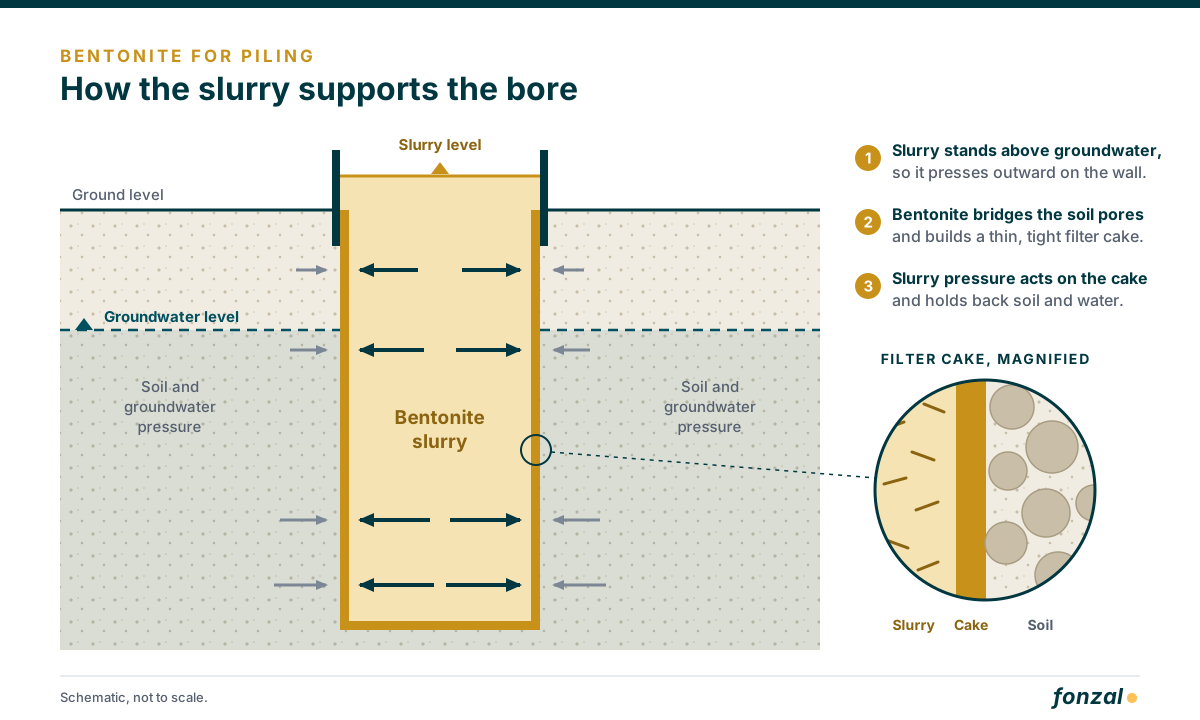
The cake is what makes the method work. Without it, the slurry would simply drain into the ground. The best result is a cake that forms on the surface of the soil within moments, with almost no bentonite entering the pores. The cake is denser than the slurry that formed it: a slurry of about 5% bentonite produces a cake of about 15% bentonite.
In coarser ground the slurry travels further before it seals. In gravel the seal can form 40 to 50 mm inside the soil, which is why a thicker slurry is used there. In very open ground with cobbles and boulders, slurry alone may not be retained and other measures are needed.
What the slurry has to do
A support fluid has six jobs, and they pull in opposite directions.
| During excavation | Before and during concreting |
|---|---|
| Support the wall by hydrostatic pressure | Be displaced cleanly by the rising concrete |
| Stay in the excavation and not drain into the soil | Release sand and silt easily in the cleaning plant |
| Keep fine soil in suspension so it does not settle at the base | Pump easily over the length of the site |
The first column calls for a thicker fluid with more gel strength. The second calls for a thin, clean fluid. A piling slurry is therefore kept inside a band: thick enough to seal and suspend, thin enough to clean, pump and displace. The tests below define that band.
The sequence on site
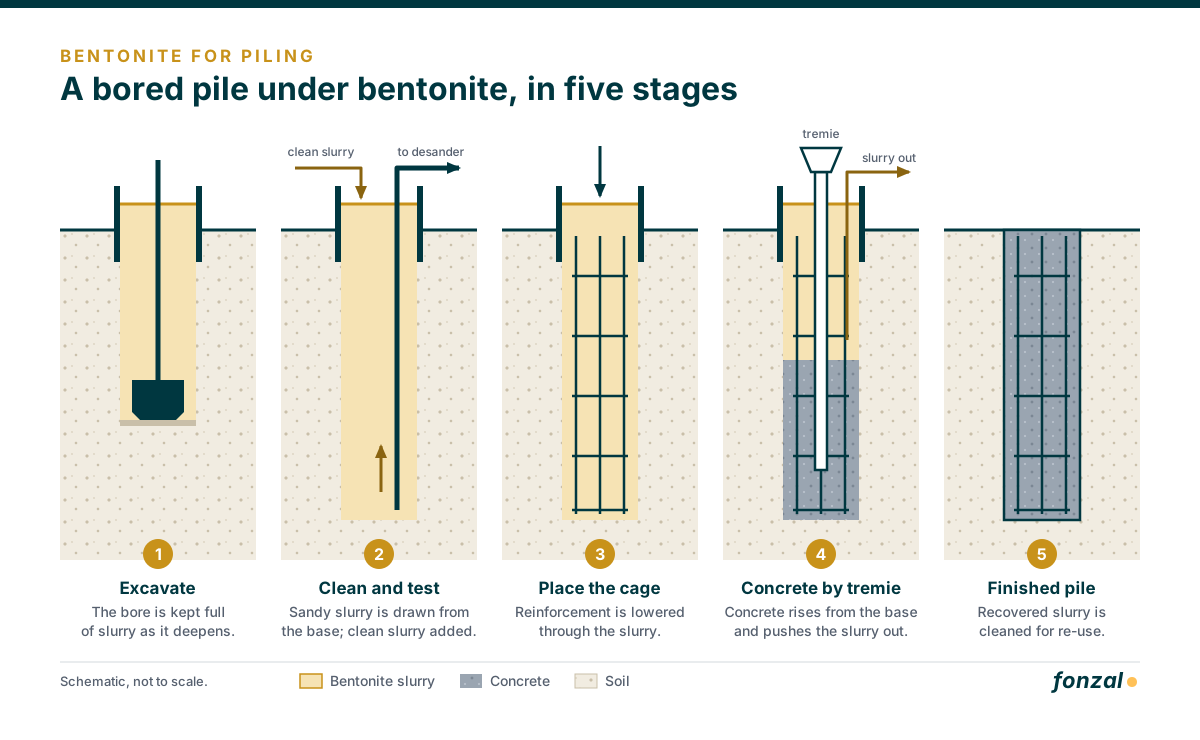
- Excavate. A short casing or guide wall holds the top of the excavation. Below it, the bore is kept full of slurry as it deepens.
- Clean and test. At full depth the slurry carries sand and silt from the dig. A sample is taken from the bottom of the excavation and tested. If it is too sandy, slurry is drawn off from the base while clean slurry is added at the top.
- Place the cage. The reinforcement is lowered through the slurry.
- Concrete by tremie. Concrete is placed through a tremie pipe that reaches the base. It rises from the bottom and pushes the lighter slurry up and out, where it is pumped back to the plant.
- Finish. The recovered slurry is cleaned and stored for the next pile.
Slurry properties and test limits
The figures most widely used on site come from the Federation of Piling Specialists’ guidance on bentonite support fluids. They set limits for the slurry at three stages.
| Property | Fresh | Ready for re-use | Before concreting | Test |
|---|---|---|---|---|
| Density (g/ml) | < 1.10 | < 1.25 | < 1.15 | Mud balance |
| Marsh viscosity, 946 ml (seconds) | 32 to 50 | 32 to 60 | 32 to 50 | Marsh funnel |
| Fluid loss, 30 minutes (ml) | < 30 | < 50 | Not applicable | Filter press |
| pH | 7 to 11 | 7 to 12 | Not applicable | pH meter |
| Sand content (%) | Not applicable | Not applicable | < 4 | Sand content set |
What each test shows:
- Density measures how much soil the slurry is carrying. A fresh slurry is only slightly denser than water. The figure rises as fine soil builds up, and a heavy slurry is harder for concrete to displace.
- Marsh viscosity is the time a set volume takes to run out of a standard funnel. About 32 seconds is the minimum for the slurry to stay in clay, silt or sand. Gravel may need 40 to 50 seconds. Above 50 seconds, cleaning becomes harder and the concrete may not displace the slurry fully around dense reinforcement.
- Fluid loss is the water that passes through a filter cake under pressure in 30 minutes. A low figure means a tight cake. It can worsen with repeated use even while the other values stay within limits, so it is checked regularly.
- pH shows contamination. Cement raises it, and acidic ground or groundwater lowers it. Either change thickens the slurry and increases fluid loss.
- Sand content is checked on the sample from the base of the excavation before concreting. Sand left in the slurry settles on the base of the pile and on the reinforcement.
The limits that apply to a project are those in its own specification, which may differ from the figures above.
Mixing and the slurry circuit
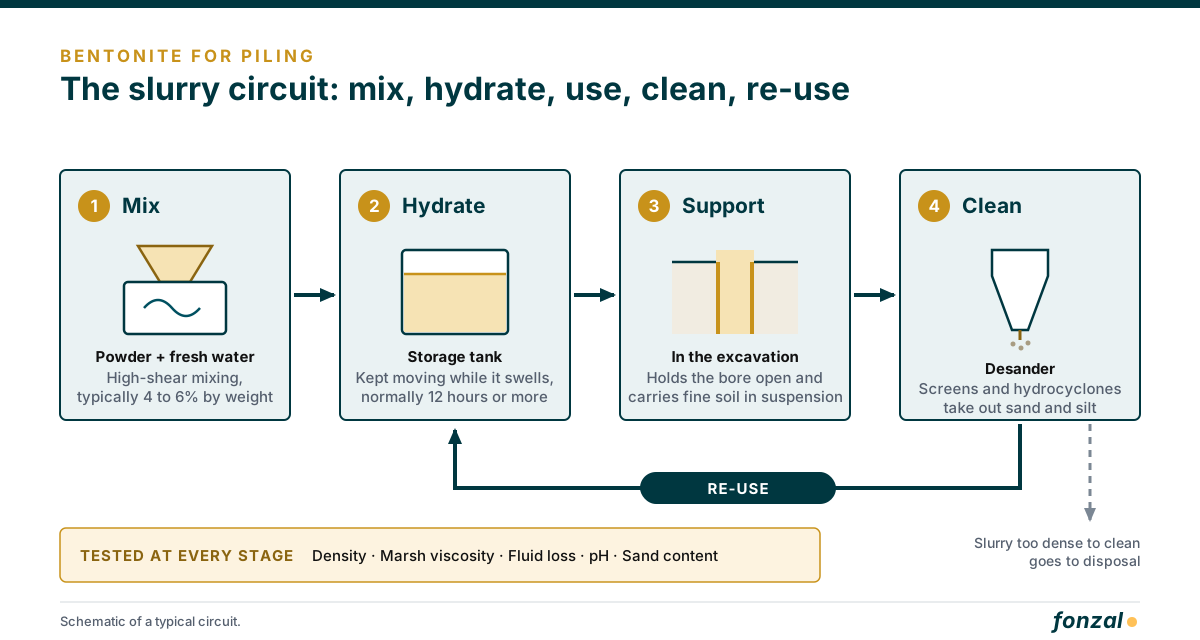
Water. Clean, fresh water of drinking quality gives the best result. Salt water should not be used: salt prevents the clay from hydrating, and there is no simple treatment to remove it. Hard water also holds the bentonite back, but it can be treated before mixing, with soda ash for calcium and caustic soda for magnesium.
Concentration. Most piling slurries contain between 4% and 6% bentonite by weight. The exact figure depends on the quality of the bentonite and the viscosity required, and is settled by trial mixes with the site water.
Mixing. The powder is added gradually through a venturi hopper or directly into a high-shear mixer, so that every particle is wetted. Powder added too quickly forms lumps that are dry inside and never hydrate.
Hydration. The clay continues to swell after mixing. The slurry is normally held in tanks for at least 12 hours, kept moving by pumps, before it is used.
Cleaning. Used slurry passes over a coarse screen and then through hydrocyclones, which spin out the sand and coarse silt. Heavily loaded slurry may need two or three passes.
Re-use and disposal. Cleaned slurry is blended with fresh slurry and used again. Clay-sized particles cannot be removed by site plant, so the density rises slowly over repeated use. When it can no longer be brought within the limit, the slurry is taken away for disposal.
Keeping the slurry in condition
| Sign | Likely cause | Usual correction |
|---|---|---|
| pH rising | Cement contamination during concreting | Sodium bicarbonate |
| pH falling | Acidic ground or groundwater | Soda ash |
| Viscosity and fluid loss rising together | Contamination causing the clay to flocculate | Correct the pH first, then thinners if needed |
| Density rising | Build-up of fine soil | Further cleaning, dilution with fresh slurry, or disposal |
| Sand content above the limit before concreting | Sand held in suspension | Exchange the slurry from the base of the excavation |
Flocculation is the condition to avoid. The clay particles clump together, the filter cake becomes permeable, fluid loss rises sharply, and the excavation can lose its support. For this reason the pH is corrected before any other property is adjusted.
Which bentonite to specify for piling
The slurry is only as good as the powder. Piling specifications usually call for a sodium bentonite that meets a recognised standard, and the Federation of Piling Specialists’ guidance describes a bentonite as normally satisfactory for support fluids if it complies with one of two:
- API Specification 13A, OCMA grade bentonite (formerly OCMA DFCP-4). This sets a minimum viscosity, a maximum filtrate volume of 16 ml, a maximum moisture content of 13% and a maximum residue of 2.5% coarser than 75 micrometres.
- EEMUA Publication 163, which requires a yield of at least 16 m³ per tonne and 98% passing a 100 mesh sieve.
Three properties of the powder matter most on a piling site:
- Yield. The volume of slurry of standard viscosity that one tonne produces. A higher yield means less powder for the same volume of slurry.
- Filtrate. A low filtrate volume in the laboratory test means a tight filter cake in the ground.
- Fineness and moisture. Coarse residue does not swell and wears pumps and cyclones. Moisture is weight that is not clay.
Fonzal supplies sodium bentonite to API 13A OCMA grade (DFCP-4) with a minimum yield of 16.5 m³ per ton, in 25 kg bags. The background to the grade is set out in our guide to the OCMA DFCP-4 specification, and supply details are on the bentonite in the UAE page. A technical data sheet and safety data sheet are available with every enquiry.
Standards and further reading
- Federation of Piling Specialists, Bentonite Support Fluids in Civil Engineering, 2nd edition, 2006.
- API Specification 13A, Drilling Fluids Materials.
- BS EN 1536, Execution of special geotechnical work: Bored piles.
- BS EN 1538, Execution of special geotechnical work: Diaphragm walls.
This guide is general information. The method, test frequencies and acceptance limits for any project are those set by its specification and its piling contractor.
Need earthing or drilling materials in the UAE or GCC?
Fonzal supplies sodium bentonite, industrial salt, charcoal powder and earthing compound from our Sharjah warehouse, with delivery across the UAE and export throughout the GCC.
Request a QuoteView Products