

An earth electrode is only as good as the ground around it. In dry or sandy soil, a rod can be driven to full depth and still read a high resistance, and the reading can drift with the seasons. A backfill of bentonite powder for earthing is the usual way to improve and steady that contact. This guide explains why soil resistivity and moisture decide the result, how bentonite changes it, how the backfill is placed in a borehole, pit or trench, how to estimate the quantity, and how bentonite compares with salt, charcoal and engineered earthing compounds.
Why the soil sets the resistance of an earth
Two terms are easily confused. Resistivity is a property of the soil itself, measured in ohm metres (Ω·m). Resistance, or earth resistance, is the figure an earth tester reads for one electrode, in ohms, and it depends on both the soil and the size and shape of the electrode.
For a single vertical rod, the resistance is commonly calculated as:
R = ρ / (2πL) × [ln(8L / d) − 1]
where ρ is the soil resistivity, L the buried length of the rod and d its diameter. Two things follow. The resistance rises in direct proportion to the soil resistivity, so the soil matters more than anything else. And the diameter appears only inside a logarithm, so a thicker rod helps a little, while a longer rod helps a lot.
Current leaves the electrode in all directions and spreads out as it travels. The soil closest to the electrode carries the most concentrated current, so it contributes the largest share of the resistance. That is the zone a backfill treats.
Why moisture matters
Soil conducts mainly through the water held in its pores and the salts dissolved in that water. Dry mineral grains are close to insulators, and so is pure water. The same soil can therefore change its resistivity many times over between a wet and a dry season.
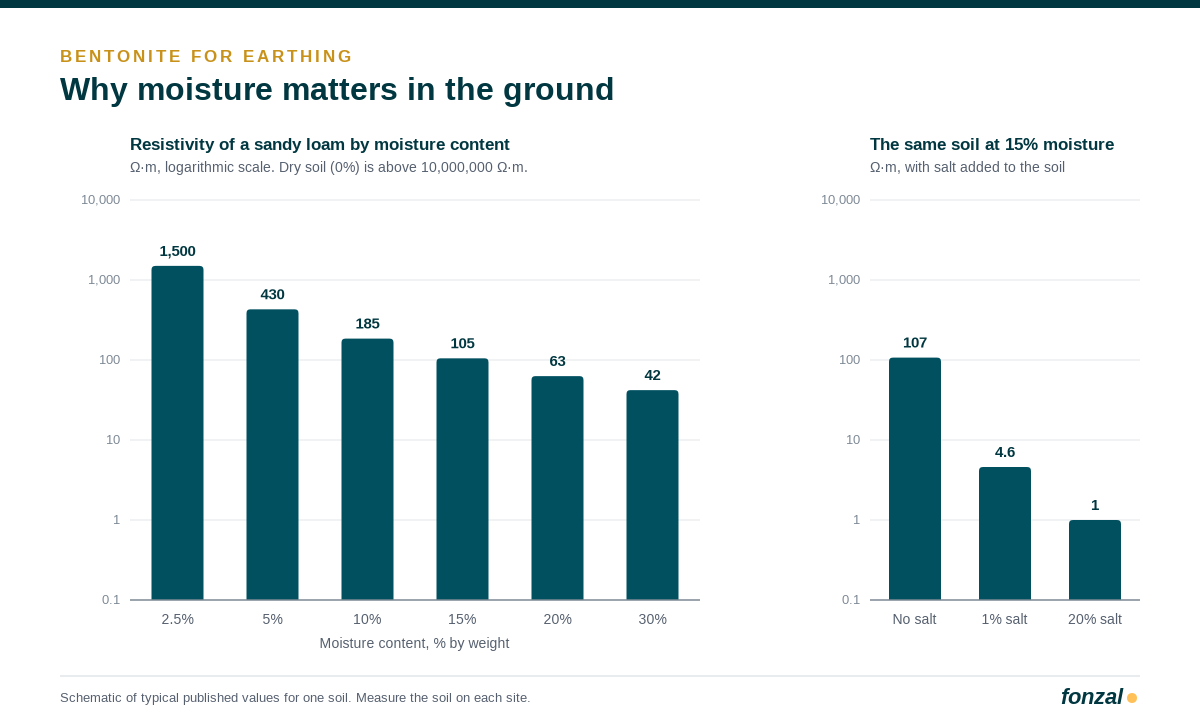
| Moisture content (% by weight) | Sandy loam resistivity (Ω·m) |
|---|---|
| 0 | Over 10,000,000 |
| 2.5 | 1,500 |
| 5 | 430 |
| 10 | 185 |
| 15 | 105 |
| 20 | 63 |
| 30 | 42 |
The steep part of the curve is at the dry end: between 2.5% and 10% moisture the resistivity of this soil falls by a factor of about eight. Above about 20% the gain from extra water is much smaller. An earth that is tested in a wet month and relied on in a dry one can therefore read very differently.
Dissolved salts have a similar effect. The same sandy loam at 15% moisture reads about 107 Ω·m with no salt added, 4.6 Ω·m with 1% salt and about 1 Ω·m with 20% salt. This is why salt has long been used in earth pits, and also why its effect fades: what dissolves can be washed away.
Published tables like this one are for a particular soil. The resistivity of a site is measured on the site, normally by the four-electrode Wenner method described in IEEE Std 81.
How bentonite lowers and stabilises the resistance
Bentonite is a clay made mostly of montmorillonite. Sodium bentonite absorbs water and swells, and a fully wetted bentonite can occupy many times its dry volume. In an earth installation that swelling does three jobs.
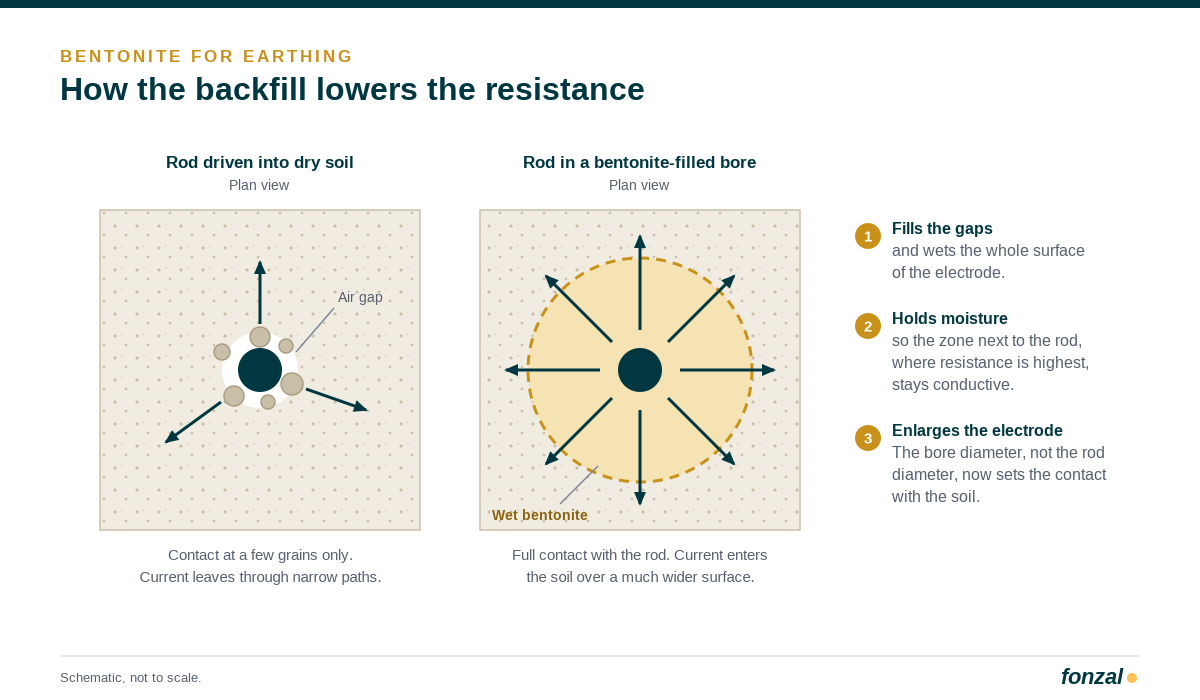
- It closes the gaps. A rod driven into dry or granular soil touches it only at a few grains, and the soil can shrink away from the rod as it dries. A swelling clay fills those voids and adheres to the electrode, so the whole surface of the rod is in contact with a conductive material.
- It holds moisture. Bentonite retains water in the immediate vicinity of the electrode and draws on moisture in the surrounding soil, such as rainfall. The zone with the highest current density stays conductive for longer.
- It enlarges the electrode. Wet bentonite has a low resistivity: IEEE Std 80 gives about 2.5 Ω·m at 300% moisture, and manufacturers’ literature gives installed values from about 3 Ω·m upwards depending on moisture. That is far lower than most soils, so the soil effectively sees an electrode as wide as the backfilled bore.
What happens to the current
Current leaves the rod across its whole surface and flows outwards through the soil, passing through a series of ever wider cylindrical shells. A shell close to the rod has a small surface area, so the current through it is crowded and that thin layer of soil adds a large share of the resistance. A shell of the same thickness a metre away has a far larger area and adds very little. Most of the resistance of an earth is therefore built up in the soil nearest the electrode.
A bentonite backfill replaces exactly that soil. Wet bentonite conducts many times better than most soils, so the current crosses the backfill with almost no loss and enters the soil from the outer face of the bore rather than from the surface of the rod. In effect, the electrode becomes as wide as the backfilled hole, and the most crowded part of the current path now runs through a good conductor instead of through dry ground. Because the backfill is so much more conductive than the soil, its exact resistivity matters little once it is wet: the gain comes from the change in geometry, not from the clay being a slightly better conductor.
The interface matters as much as the bulk. Where a driven rod touches dry or granular soil only at scattered grains, the current is squeezed through those few points of contact, and air in the gaps carries none. The swelling clay presses against both the rod and the wall of the bore, so current can pass over the whole surface on both sides. In dry sand this improvement in contact is often larger than the gain from the wider electrode.
The limit is the soil beyond the backfill. The outer shells, where the current has already spread out, are untouched, and in a high-resistivity soil they still set much of the total. Widening the bore therefore brings diminishing returns. A longer rod, a deeper bore or several electrodes reach more soil, and often deeper, wetter layers, so they do more where a large reduction is needed. The bentonite’s role is to keep each of those electrodes in full, moist contact with the ground through the seasons.
Is bentonite good for earthing?
IEEE Std 80 describes bentonite as non-corrosive and stable, which suits copper and galvanised steel electrodes. It also notes the limit of the material: it needs water to keep its properties, and in a very dry environment it may shrink away from the electrode and raise the resistance. Bentonite for earthing works best where the ground holds some moisture through the year and the backfill sits below the depth to which the surface dries out.
How to use bentonite powder for earthing
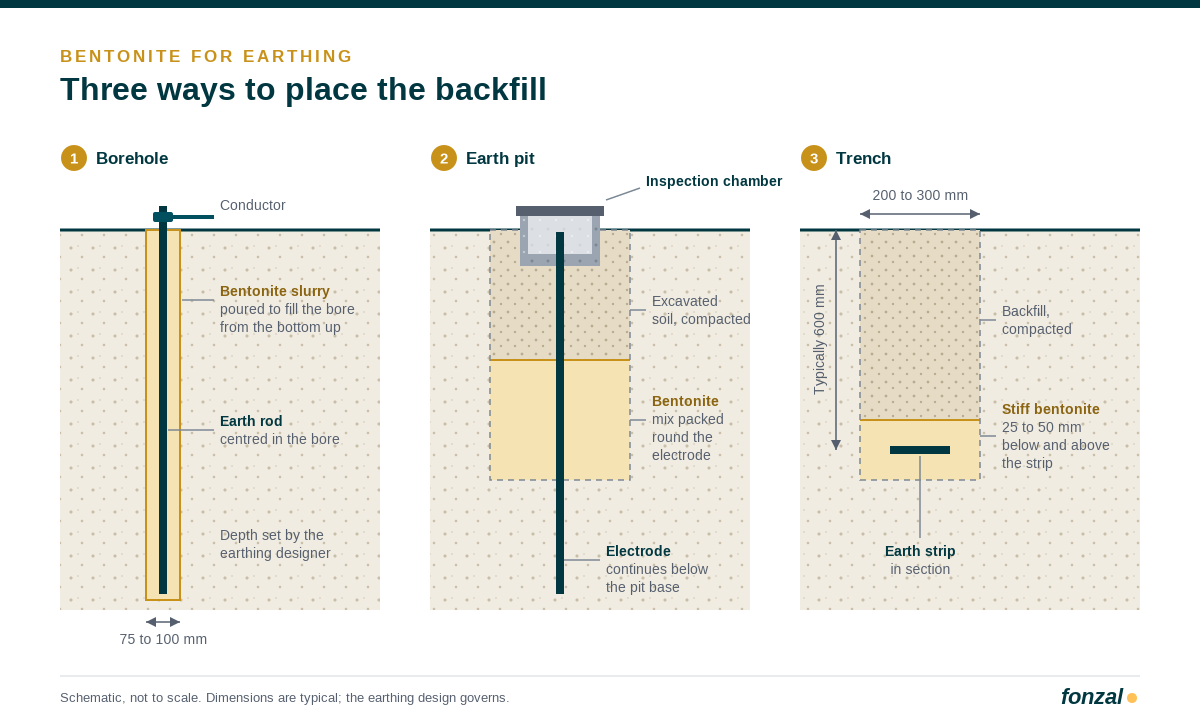
Borehole. The method used most for vertical rods in dry or hard ground.
- Bore a hole at the rod position, typically 75 to 100 mm in diameter, to the depth set by the earthing designer.
- Insert the rod and centre it, with its top at the level needed for the connection.
- Fill the bore with a bentonite slurry thin enough to reach the bottom of the hole. Moving the rod as the slurry goes in helps release trapped air and avoid voids.
Earth pit. A pit is dug around the electrode, the electrode is placed, and a bentonite mix is packed around it in the lower part of the pit. The remainder is refilled with excavated soil, compacted, and an inspection chamber at the top gives access to the connection for testing.
Trench. For horizontal strips and conductors.
- Dig a trench 200 to 300 mm wide to the depth in the design, typically about 600 mm.
- Lay a stiff bentonite mix 25 to 50 mm thick on the base and press the strip into it without pushing it through.
- Cover the strip with another 25 to 50 mm of bentonite, then backfill and compact the trench.
Water. Mix with clean fresh water. As with bentonite slurry for piling, salt and hard water hold the clay back from hydrating, and powder added too quickly forms lumps that stay dry inside. Bentonite powder for earthing is the easier form to pour into a borehole; a stiffer mix suits trenches and pits.
How much bentonite a pit or borehole needs
The quantity follows from the volume to be filled and the amount of dry bentonite in each cubic metre of mix.
- Volume of backfill. For a borehole, the space around the rod is π/4 × (D² − d²) × L. For a trench, it is the width multiplied by the total thickness of bentonite and the length.
- Bentonite per cubic metre of mix. This depends on how much water is added. A common rule of thumb in manufacturers’ literature assumes the mix occupies about twice the volume of the dry powder, which gives about 450 kg of bentonite per m³ of backfill.
- Allowance. Add a margin for slurry lost into open ground and for over-sized holes.
Worked examples, using the rule of thumb:
| Installation | Volume of backfill | Bentonite |
|---|---|---|
| 100 mm borehole, 3 m deep, 16 mm rod | 0.023 m³ | About 10 kg |
| Trench 300 mm wide, 50 mm below and above the strip | 0.03 m³ per metre | About 13.5 kg per metre |
The mix proportions and quantities for a project are those of its earthing design and the data sheet of the bentonite used.
Bentonite compared with salt, charcoal and engineered compounds
Bentonite is not the only material used to treat the ground around an earth electrode. The usual alternatives are salt, charcoal and engineered compounds.
| Backfill | How it works | Strength | Limitation |
|---|---|---|---|
| Sodium bentonite | Swells, fills voids and holds water around the electrode | Non-corrosive and stable; keeps the electrode in contact | Needs ground moisture; may shrink away in very dry conditions |
| Salt | Dissolves in soil water and lowers its resistivity | Large immediate reduction | Leaches away and must be renewed; risk of corrosion and of spreading into surrounding ground |
| Charcoal | Used in traditional pits, usually in layers with salt, to hold moisture | Long-established practice | Depends on the moisture and salt around it |
| Engineered earthing compound | Conductive material placed as a backfill, some types setting into a solid mass | Low resistivity; types that set do not rely on soil moisture | Choose a compound tested to IEC 62561-7 and follow its mixing method |
IEEE Std 80 notes that salts dissolve and leach out of the treated zone, so they must be renewed, and that this leaching may not be allowed in some places. BS 7430 states that chemical treatment of soil should not be considered a long-term solution for meeting a specified resistance, given its environmental implications and the risk of corrosion to the earthing system. It also states that coke breeze should not be used because of its highly corrosive nature.
Where moisture cannot be relied on at all, or a very low and permanent value is required, an engineered earthing backfill compound is the usual alternative. Traditional pits that use earthing charcoal and salt remain common for smaller installations, and bentonite is often specified alongside them to hold moisture at the electrode.
Standards for earthing and backfill materials
- IEC 62561-7 specifies the requirements and tests for earthing enhancing compounds. The third edition, of 2024, replaced the 2018 edition. It covers resistivity, corrosion and, since 2024, pH.
- BS 7430 is the British code of practice for protective earthing. It covers electrode design and resistance formulae, and gives the guidance on soil treatment and coke breeze quoted above.
- IEEE Std 80 is the guide for safety in AC substation grounding. Its clause on soil treatment describes bentonite, salts and ground enhancing materials.
- IEEE Std 142 (the Green Book) covers grounding of industrial and commercial power systems, including soil resistivity and its variation with moisture, salt and temperature.
- IEEE Std 81 gives the methods for measuring soil resistivity and the resistance of an earthing system.
Which bentonite to specify for earthing
An earthing backfill relies on swelling and on holding water, so sodium bentonite powder for earthing should be a high-swelling grade. Three properties of an earthing bentonite matter most:
- Swelling and yield. A higher yield means more swelling and more water held by each kilogram of clay. The same property makes bentonite the standard support fluid for bored piles.
- Fineness. A fine powder disperses quickly and pours to the bottom of a narrow bore. Sand and coarse residue do not swell and leave weaker, more permeable spots in the backfill.
- Moisture in the bag. Water already in the powder is weight that is not clay.
Fonzal supplies bentonite powder to API 13A OCMA grade (DFCP-4), suitable for earthing and grounding, in 25 kg bags. It has a minimum yield of 16.5 m³ per ton, sand content below 2.5%, a minimum of 98% passing a 100 mesh screen, maximum moisture of 13% and a pH of 6 to 9. The meaning of the grade is explained in our guide to the OCMA DFCP-4 specification, its other uses in the sodium bentonite uses guide, and supply details on the bentonite in the UAE page. A technical data sheet and safety data sheet are available on enquiry.
Standards and further reading
- IEC 62561-7:2024, Lightning protection system components (LPSC). Part 7: Requirements for earthing enhancing compounds.
- BS 7430:2011+A1:2015, Code of practice for protective earthing of electrical installations.
- IEEE Std 80-2013, IEEE Guide for Safety in AC Substation Grounding.
- IEEE Std 142-2007, IEEE Recommended Practice for Grounding of Industrial and Commercial Power Systems.
- IEEE Std 81-2012, IEEE Guide for Measuring Earth Resistivity, Ground Impedance, and Earth Surface Potentials of a Grounding System.
- M. Kizlo and A. Kanbergs, “The Causes of the Parameters Changes of Soil Resistivity”, Scientific Proceedings of Riga Technical University, 2009.
This guide is general information. The electrode design, backfill, test method and acceptance values for any installation are those set by its earthing design and specification.
This guide was written with AI assistance from published standards and technical sources, and reviewed by Fermil Muhammed, Technical Engineer at Fonzal.
Need earthing or drilling materials in the UAE or GCC?
Fonzal supplies sodium bentonite, industrial salt, charcoal powder and earthing compound from our Sharjah warehouse, with delivery across the UAE and export throughout the GCC.
Request a QuoteView Products