
This bentonite calculator works out how much sodium bentonite powder a batch of slurry needs. Enter the volume of slurry, or the size and depth of a bore, and the concentration of the mix. It returns the bentonite in kilograms, the number of 25 kg bags, the water to mix it with and the density the fresh slurry should read on a mud balance. The assumptions behind every figure are set out below the results.
Assumptions
- The concentration is the weight of bentonite as a percentage of the weight of the mix water, the convention used for piling support fluids. At 5%, 1,000 kg of water takes 50 kg of bentonite.
- The bentonite has a grain density of 2.5 g/cm³ and the water 1.0 g/cm³. The volume entered is the volume of finished slurry, water and bentonite together.
- Bags are 25 kg and the count is rounded up to whole bags.
- The extra percentage is your own allowance for slurry held in tanks and pipes, lost to the ground or replaced. It is added to the bentonite, the bags and the water. It is zero unless you enter a figure.
- The density is that of a fresh mix of bentonite and clean water, before it has carried any soil.
How the bentonite calculator works
A slurry is made of two things, water and bentonite, and together they fill the volume. Because the concentration is a share of the weight of the water, the water in each cubic metre is found first: its volume plus the volume of the bentonite (its weight divided by 2.5) must make 1,000 litres. At 5%, that gives about 980 litres of water and 49 kg of bentonite in each cubic metre of slurry. The calculator multiplies those figures by the volume you enter.
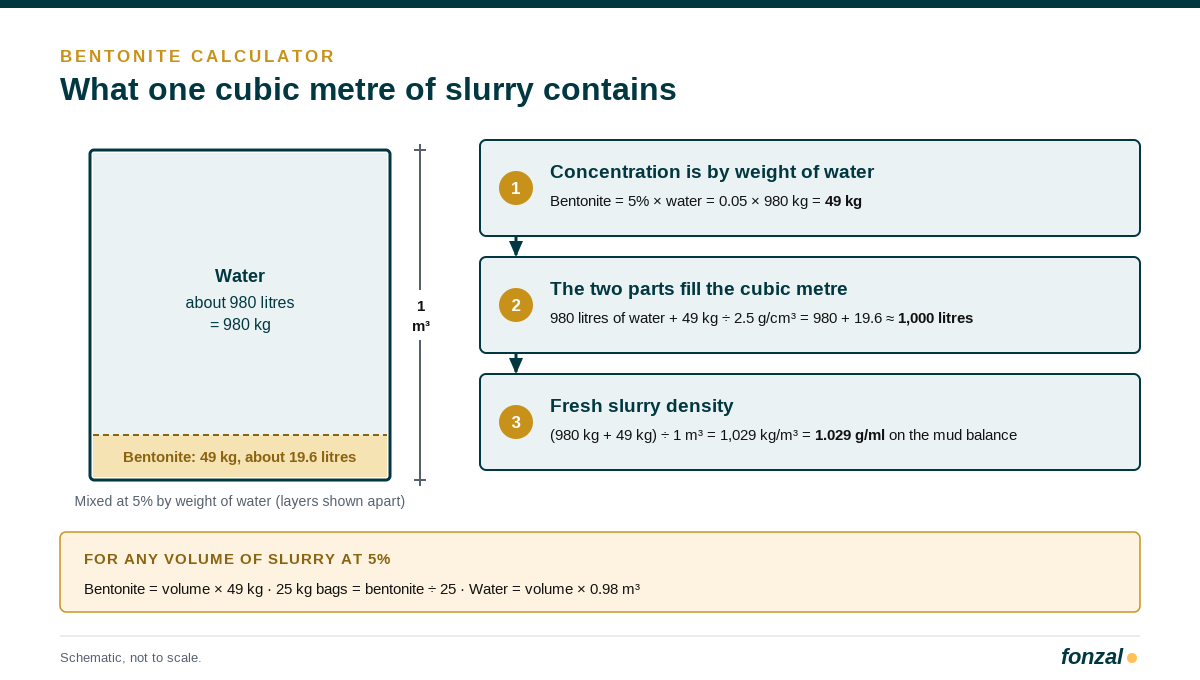
The bentonite takes up very little room: the solid volume of 49 kg of powder is only about 20 litres. That is why the slurry is only slightly heavier than water, and why its density on site says more about the soil it has picked up than about the bentonite in it, as our guide to bentonite slurry for piling explains.
Bentonite per cubic metre of slurry
The same arithmetic, worked out for the usual range of mixes:
| Bentonite, by weight of water | Bentonite per m³ of slurry | 25 kg bags per m³ | Water per m³ of slurry | Fresh slurry density |
|---|---|---|---|---|
| 3% | 29.6 kg | 1.19 | 0.988 m³ | 1.018 g/ml |
| 4% | 39.4 kg | 1.57 | 0.984 m³ | 1.024 g/ml |
| 5% | 49.0 kg | 1.96 | 0.980 m³ | 1.029 g/ml |
| 6% | 58.6 kg | 2.34 | 0.977 m³ | 1.035 g/ml |
| 7% | 68.1 kg | 2.72 | 0.973 m³ | 1.041 g/ml |
| 8% | 77.5 kg | 3.10 | 0.969 m³ | 1.047 g/ml |
Piling slurries are usually mixed at 4% to 6% by weight of water, according to the Federation of Piling Specialists' guidance on bentonite support fluids. For drilling mud, the US Army Corps of Engineers gives about 50 pounds of bentonite per 100 US gallons of water as a starting point, roughly 60 kg per cubic metre of water or 6%; our guide tobentonite drilling mud covers how that mix is adjusted. In both cases the working figure is settled by trial mixes with the site water, checked on the Marsh funnel.
Bentonite quantity calculation for a pile
For a bored pile, the slurry needed to fill the bore is its volume: π × D² ÷ 4 × depth, with the diameter D in metres. Open "Work out the volume from a bore" in the calculator to do this step for you.
Worked example. A 1,000 mm bore 25 m deep holds 0.785 × 25 = 19.6 m³ of slurry. At 5%, that slurry holds 19.6 × 49 = about 962 kg of bentonite, or 38.5 bags, which rounds up to 39 bags of 25 kg. It is mixed with about 19.2 m³ of water.
How many bentonite bags are required for a 1 m bore?
One metre of depth in a 1,000 mm bore holds 0.785 m³ of slurry. At 5% that needs about 38.5 kg of bentonite, or about 1.5 bags of 25 kg per metre. At 4% it is about 1.2 bags, and at 6% about 1.8. A table for other diameters is in the piling guide's section on bentonite per metre of bore.
What the calculator does not include
The bentonite calculator gives the bentonite in the volume you enter. The bentonite a job uses is higher, for four reasons:
- The circuit. Mixing and storage tanks, pipework and the desander hold slurry of their own, and that volume has to be made before the first bore is filled.
- Losses to the ground. Some slurry is lost into the soil before the filter cake seals, more in coarse ground than in clay.
- Overbreak. A bore larger than its nominal diameter holds more slurry than the calculation shows.
- Replacement. Slurry that can no longer be cleaned within its limits is disposed of and replaced with fresh slurry.
On a piling job the slurry is cleaned and used again from pile to pile, so the bentonite for the whole job is not the bentonite per pile multiplied by the number of piles. Enter the volume of the bores open at one time plus the circuit, and use the extra percentage for losses and replacement, set from the ground and from experience on the site. The project's contractor is the right source for that allowance.
In horizontal directional drilling, far more fluid is pumped than the hole holds, because it has to carry the cuttings out as well. Enter the volume of fluid to be mixed, not the volume of the hole.
Which bentonite to use with the calculator
The quantities above assume a sodium bentonite that reaches the required viscosity at a normal concentration. A lower-quality clay needs a stronger mix for the same result, which the calculator cannot know, and is why the concentration is always confirmed by trial mixes. Yield, the volume of fluid of a standard viscosity that one ton of bentonite produces, is the property that decides how much powder a slurry needs.
Fonzal supplies sodium bentonite powder to API 13A OCMA grade (DFCP-4) with a minimum yield of 16.5 m³ per ton, in 25 kg bags. What the grade requires is set out in our guide to the OCMA DFCP-4 specification, and supply details are on thebentonite in the UAE page. A technical data sheet and safety data sheet are available on enquiry.
Standards and further reading
- Federation of Piling Specialists, Bentonite Support Fluids in Civil Engineering, 2nd edition, 2006.
- US Army Corps of Engineers, EM 1110-1-1804, Geotechnical Investigations, Appendix F, on drilling fluids.
- API Specification 13A, Drilling Fluids Materials.
- BS EN 1536, Execution of special geotechnical work: Bored piles.
This calculator gives general estimates. The mix, the test limits and the quantities for any project are those set by its specification and its contractor.
This page was written with AI assistance from published standards and technical sources, and reviewed by Fermil Muhammed, Technical Engineer at Fonzal.
Need sodium bentonite in the UAE or GCC?
Fonzal supplies API 13A OCMA grade (DFCP-4) bentonite in 25 kg bags, with delivery across the UAE and export throughout the GCC.
Request a QuoteView the Product