

Pipes and cables are now laid under roads, rivers and buildings without digging a trench, and almost all of that work runs on bentonite. This guide to bentonite for HDD explains what the mud does in a long horizontal bore, how much of it a bore needs, how a frac-out happens and how it is avoided, and how the mud is cleaned and re-used. It then covers bentonite in tunnelling, where a bentonite slurry holds up the face of a tunnel boring machine.
How does horizontal directional drilling work?
Horizontal directional drilling (HDD) installs a pipe in three passes, all made under a continuous flow of drilling fluid.
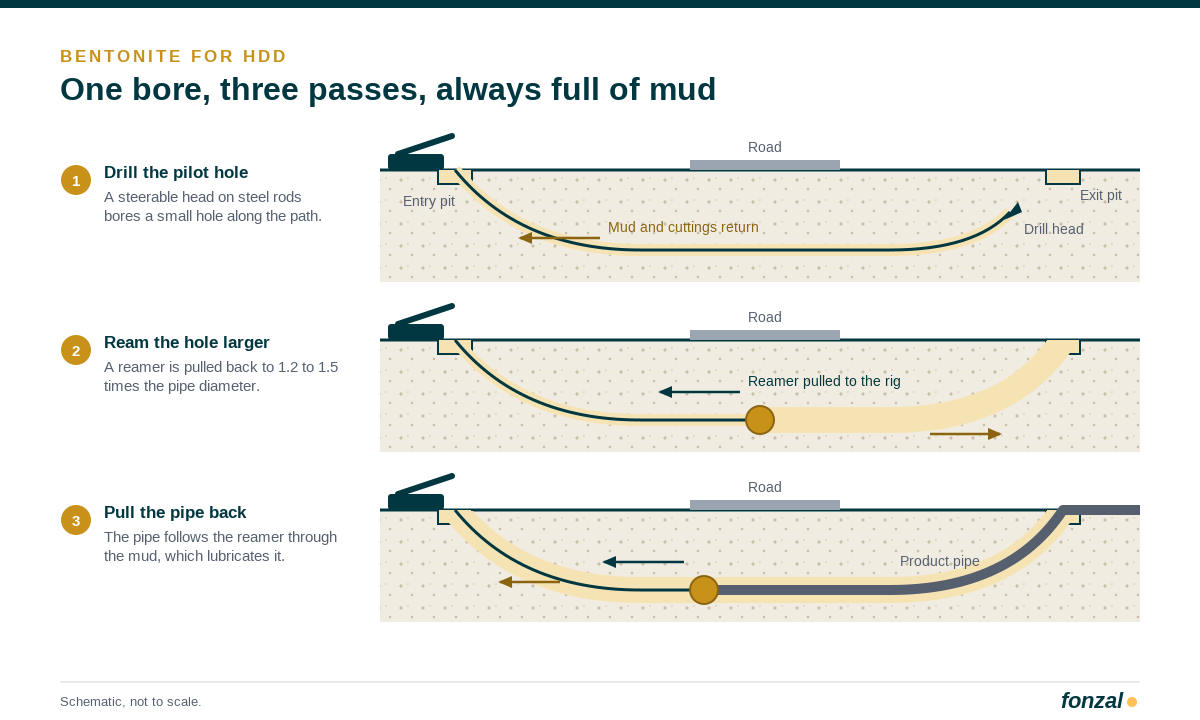
- Pilot hole. A steerable drill head on a string of steel rods bores a small hole along the planned path, under the obstacle, and is tracked from the surface until it comes out on the far side.
- Reaming. A reamer is attached and pulled back through the pilot hole to enlarge it. Large holes are reamed in several passes. The finished hole is typically 1.2 to 1.5 times the diameter of the pipe, and a final swab pass with the same reamer is often made to clean the hole before the pipe goes in.
- Pullback. The pipe is pulled back through the hole behind the reamer, usually in one length. Pullback typically runs at one to several feet per minute, roughly 0.3 to 2 m. Pulling faster than the mud can be pumped can cause hydrolock, where the rig cannot overcome the pressure building up at the reamer.
What is HDD drilling mud?
HDD drilling mud is, in most cases, sodium bentonite dispersed in fresh water, with soda ash to treat the water and sometimes polymers for particular ground. The clay swells in water and gives a fluid that thickens to a gel when it stands and thins again when it is pumped.
In a bore that may run hundreds of metres almost level, the mud has to:
- Carry the cuttings. The mud mixes with the soil cut by the bit and reamer and carries it out of the hole as a slurry.
- Hold them in suspension. A horizontal hole has no gravity to help. When pumping stops, the gel strength keeps the cuttings from settling into a bed along the bottom of the hole.
- Build a filter cake. The clay forms a thin, low-permeability layer on the wall that keeps the water in the mud and stops it draining into the ground.
- Hold the hole open. The mud pressure acting on that cake supports the wall of the hole in sand and gravel until the pipe is in.
- Lubricate. The mud reduces drilling torque and the friction between the pipe and the hole during pullback.
- Cool the tools. The flow takes heat away from the drill head and the reamer.
After pullback, the mud left around the pipe gels and thickens. Unless cement is added, it may be no stiffer than a very soft clay, so it should not be counted on to support the pipe.
Why bentonite for HDD
Sodium bentonite gives viscosity, gel strength and a tight filter cake at a low concentration, and it does them together. Its flat clay platelets lie against the borehole wall and overlap, which is why the cake is thin, and the same platelets link into a gel that holds cuttings when the flow slows. Water alone does none of this.
The sodium form matters because it swells far more in fresh water than calcium bentonite, so less powder is needed to reach the working viscosity. The tests a drilling clay must pass are those in API Specification 13A, explained in our guide to drilling bentonite and how mud is tested.
Polymers are added to HDD bentonite for particular ground. A polyanionic cellulose (PAC) polymer improves filtration control in a bentonite mud. In ground with a lot of reactive clay, which swells and sticks to the tools, a PHPA polymer fluid may be used instead of bentonite.
Viscosity, water and mixing
Water. Check the pH and hardness of the mixing water first. One field guide puts the best range for mixing additives at a pH of 8 to 9, and notes that pond and well water usually falls below it. Soda ash raises the pH and takes calcium out of solution, so it is dissolved in the water before the bentonite goes in. Salt water should not be used.
Mixing. Add the bentonite through the hopper of a high-shear or venturi mixer, a little at a time. Allow the bentonite to mix fully, usually about 10 minutes, before any polymer is added, and add polymers last.
Viscosity. HDD crews check the mud with the Marsh funnel, timing one quart in seconds. Water runs through in about 27 seconds. Field guides give these working figures:
| Ground | Typical Marsh funnel viscosity |
|---|---|
| Most drilling | 45 to 60 seconds |
| Clay | Low 40s |
| Sand | Mid 60s |
The mud should be no thicker than the ground needs. A thicker mud takes more pressure to pump, and pressure in the hole is what drives a frac-out, described below.
How much drilling fluid does an HDD bore need?
The fluid needed is worked out from the volume of the hole and the ground being drilled.
Hole volume. The volume of a round hole in litres per metre is its diameter in millimetres squared, divided by 1,273. A hole reamed to 300 mm holds about 71 litres per metre, so a 200 m bore holds about 14,000 litres.
Fluid ratio. The mud has to fill the hole and also carry out the soil cut from it, so more fluid is pumped than the hole holds. One field guide gives these ratios of fluid to hole volume:
| Ground | Fluid volume pumped |
|---|---|
| Sand | 2 to 3 times the hole volume |
| Clay | 3 to 5 times the hole volume |
Clay needs more because its cuttings swell and stick, and have to be carried out without blocking the hole. The ratio also sets the pace: each rod length of reaming or pullback should not advance faster than the pump can deliver its share of fluid. Outrunning the fluid is a common cause of collapsed holes, stretched pipe and inadvertent returns.
The amount of bentonite for HDD then follows from the fluid volume and the concentration settled by trial mixes with the site water. A higher-yield bentonite reaches the working viscosity with less powder.
What is a frac-out in HDD?
A frac-out, or hydrofracture, is a form of inadvertent return: the mud escapes from the hole and comes up at the ground surface or into a waterway, instead of flowing back along the hole to the pits.
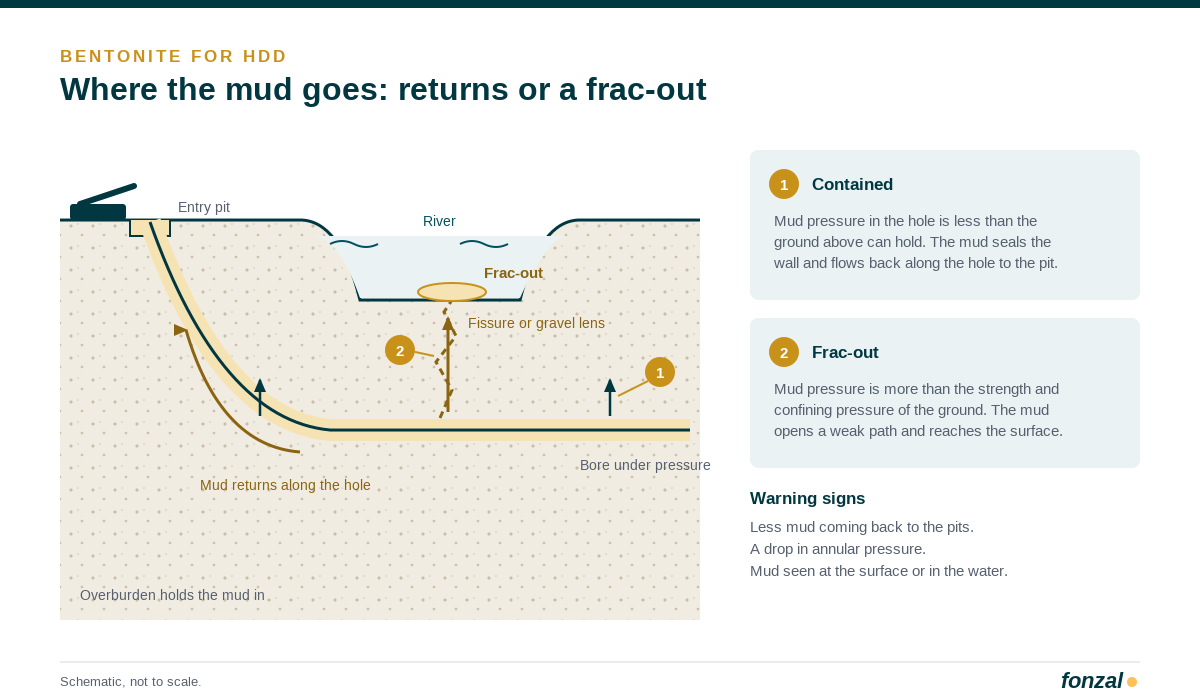
Why it happens. The mud is under pressure: the weight of the column of fluid plus the pressure needed to push it, with its cuttings, along the hole. Where that pressure is more than the strength and confining pressure of the ground above, the mud opens a path through the overburden and follows it to the surface. Fissures, gravel lenses, old boreholes and fractured rock give it an easier route. For this reason, site investigation borings are kept to one side of the drill path, so the mud cannot follow the borehole to the surface.
How it is avoided.
- Depth. HDD pipes are generally laid deeper than trenched pipes, partly to give enough ground above the bore to contain the mud.
- Low pressure in the hole. Keep the mud as thin as it can be while still suspending the cuttings. A mud whose gel keeps building in loose ground can raise the pressure enough to cause a frac-out.
- A clean hole. A thick, soft filter cake and a bed of settled cuttings narrow the space the mud has to flow through, and the pressure rises. Keep the fluid flowing at the planned rate and do not outrun it.
- Monitoring. Track the volume of mud returning to the pits, the pump and annular pressures, the rate of advance and the viscosity. A drop in returns or in annular pressure is the warning. Some contingency plans set a drop in annular pressure of more than 25% as the point at which drilling is reviewed.
What is done if it happens. Drilling is slowed or stopped, the escape path is sealed with lost circulation material pumped down the hole, the drill string may be pulled back to let the fluid in the fracture set, and the cause is corrected, often by changing the viscosity of the mud. Released mud is contained and cleaned up. A bentonite and water mud is generally considered non-toxic, but a release can still affect a river or lake, and in water the mud sinks to the bottom because it is heavier than water.
Recycling HDD drilling mud
The mud returning from the hole carries sand and silt. Pumped down again without cleaning, those solids make the mud heavier, wear the pumps and tools, and weaken its filtration control and gel strength. A recycling system cleans the mud for re-use, which saves water and bentonite and reduces the volume of spoil for disposal.
- Scalping shaker. A vibrating screen takes out the coarse cuttings.
- Hydrocyclones. Spinning the mud throws the finer sand and silt out of it. Larger desander cones are followed by smaller desilter cones, which make a finer cut.
- Fine screens. The underflow from the cones drops onto a shaker with very fine screens that dries the solids and returns the fluid. Cones mounted over a fine shaker are called a mud cleaner.
- Clean tank. The cleaned mud is topped up with fresh bentonite as needed and goes back to the rig.
One industry guide gives these working figures for a well-run system:
| Check | Figure |
|---|---|
| Capacity of the cleaning system | At least 1.5 times the rig’s maximum pump rate |
| Screen on the mud cleaner | 200 mesh or finer (a cut at about 74 µm, the lower limit of sand) |
| Density of clean mud | About 8.5 lb/gal (about 1.02) |
| Density at which part of the mud is replaced | Above 9 lb/gal (about 1.08) |
| Sand content achievable over a project | Below 0.25% |
The same principles of cleaning and re-use apply to bentonite support slurry for piling, where hydrocyclones also remove the sand between piles.
How is bentonite used in tunnelling?
Bentonite in tunnelling does two main jobs: it holds up the face of a slurry shield tunnel boring machine, and it lubricates pipes and segments as they are pushed through the ground.
Slurry shield face support
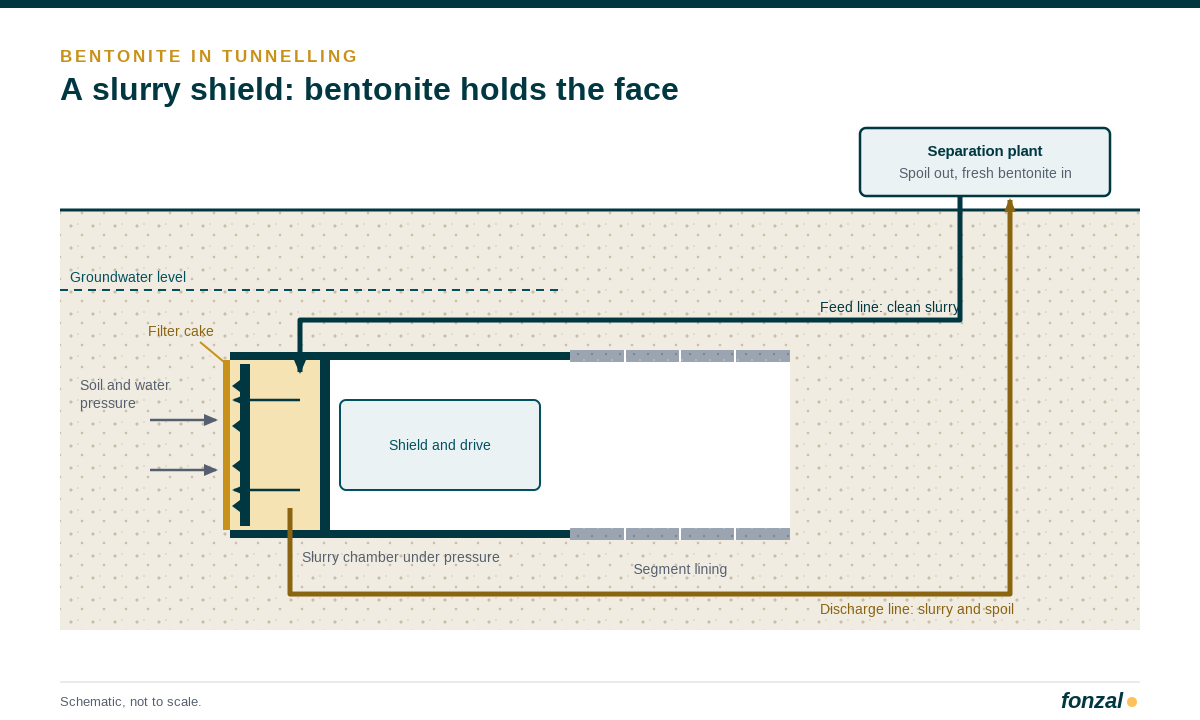
A slurry shield is a tunnel boring machine for ground that cannot support itself, mainly sand and gravel with silt, often below the water table. The cutterhead turns in a sealed chamber at the front of the machine, which is kept full of bentonite slurry under pressure.
The slurry holds the face in the same way that a slurry holds open a pile bore. The pressure pushes slurry against the face. In fine ground, the bentonite forms a filter cake on the face. In coarse ground, it soaks a short distance into the soil and gels there. Either way, the slurry pressure is passed to the soil grains and holds them in place against the soil and groundwater pressure. The depth to which the slurry soaks in has to be kept within limits: some is needed, but slurry that travels too far into the ground passes its pressure to soil well beyond the face, and the support becomes less effective.
Because the support depends on the slurry, its rheology is tightly controlled. The tests follow API 13B, the same field tests used for drilling mud, and the German standard DIN 4126 on stability of slurry-supported excavations. On site, the Marsh funnel and other simple tests are used for day-to-day control.
The slurry circuit
The excavated soil mixes with the slurry in the chamber and is pumped out through a pipeline to a separation plant, usually at the surface. There the spoil is separated and dewatered, the slurry is topped up with freshly prepared bentonite slurry, and it is pumped back to the face. In one form of slurry shield, an air cushion behind a wall in the chamber sets the face pressure separately from the flow of slurry in the pipelines.
Lubrication in pipe jacking and microtunnelling
In pipe jacking and microtunnelling, the pipes are pushed from a shaft behind a small tunnelling machine. The machine cuts a hole slightly larger than the pipe, and a fluid, normally bentonite and/or polymers, is injected into the space around the pipe. It fills that annular space, supports the ground around it, and reduces the skin friction and the force needed to jack the pipes forward.
Which bentonite to specify for HDD and tunnelling
When choosing bentonite for HDD or a slurry shield, the properties that matter in the powder are the same as for other drilling fluids:
- Yield. A high-yield sodium bentonite reaches the working viscosity with less powder, which matters when a long bore takes several times its own volume in mud.
- Filtrate. A low filtrate volume in the laboratory means a thin, tight filter cake in the hole and on the tunnel face.
- Fineness and moisture. Coarse residue does not swell, wears pumps and cones, and adds to the solids the recycling system has to remove. Moisture is weight that is not clay.
Fonzal supplies sodium bentonite to API 13A OCMA grade (DFCP-4), suitable for horizontal directional drilling and tunnelling, in 25 kg bags. It has a minimum yield of 16.5 m³ per ton, sand content below 2.5%, a minimum of 98% passing a 100 mesh screen, maximum moisture of 13% and a pH of 6 to 9. What the grade requires is set out in our guide to the OCMA DFCP-4 specification, the clay’s other uses in the sodium bentonite uses guide, and supply details on the bentonite in the UAE page. A technical data sheet and safety data sheet are available on enquiry.
Standards and further reading
- API Specification 13A, Drilling Fluids Materials (ISO 13500).
- API Recommended Practice 13B-1, Field Testing Water-based Drilling Fluids (ISO 10414-1).
- DIN 4126, Stability analysis of diaphragm walls, and DIN 4127, test methods for supporting fluids.
- ASTM F1962, Standard Guide for Use of Maxi-Horizontal Directional Drilling for Placement of Polyethylene Pipe or Conduit Under Obstacles, Including River Crossings.
- Plastics Pipe Institute, Handbook of PE Pipe, 2nd edition, Chapter 12, “Horizontal Directional Drilling”.
- North American Society for Trenchless Technology (NASTT), Horizontal Directional Drilling Good Practices Guidelines, and the NASTT glossary.
- International Tunnelling and Underground Space Association (ITA-AITES), “Slurry shield”.
This guide is general information. The drilling fluid programme, monitoring limits and acceptance criteria for any bore or tunnel are those set by its specification and its contractor.
This guide was written with AI assistance from published standards and technical sources, and reviewed by Fermil Muhammed, Technical Engineer at Fonzal.
Need earthing or drilling materials in the UAE or GCC?
Fonzal supplies sodium bentonite, industrial salt, charcoal powder and earthing compound from our Sharjah warehouse, with delivery across the UAE and export throughout the GCC.
Request a QuoteView Products