

Almost every borehole drilled with a rotary rig and a water-based fluid relies on bentonite. Drilling bentonite turns plain water into a mud that lifts the cuttings, holds the hole open and seals its wall. This guide explains what the mud does and why bentonite is used to make it, the tests in API Specification 13A and on site that it is judged by, how to mix it, and what changes when the hole is a water well.
What is bentonite drilling mud?
Bentonite drilling mud is sodium bentonite powder dispersed in fresh water. The clay is made of very thin, flat platelets. In fresh water they take up water between their layers and swell, and the suspension becomes a slightly viscous fluid that sets to a weak gel when it stands still and thins again when it is pumped.
That basic mix is often adjusted. Soda ash is added to soften hard water and raise the pH, and polymers may be added to thicken the fluid or reduce the water it loses. In an oil or gas well the mud is usually weighted and treated far beyond this. In water wells, foundation boreholes and site investigation, a bentonite drilling fluid is often little more than clay, water and a little soda ash.
What is the purpose of drilling mud?
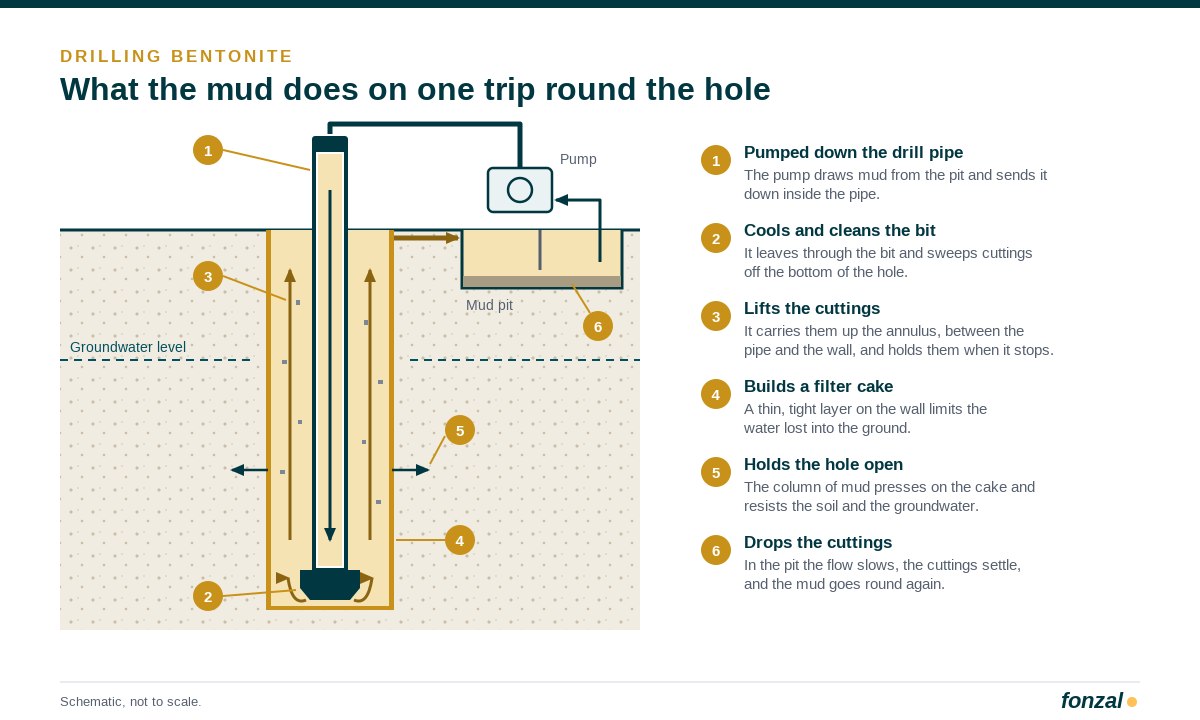
The mud is pumped down the inside of the drill pipe, leaves through the bit, and returns to the surface up the annulus, the space between the pipe and the borehole wall. On that trip it does six jobs:
- Cleans and cools the bit. The jets sweep cuttings off the bottom of the hole so the bit keeps cutting fresh ground, and the flow carries away heat.
- Lifts the cuttings. The rising mud carries the cuttings to the surface.
- Holds them when the pump stops. While a length of pipe is added, the mud gels and keeps cuttings in suspension instead of letting them settle on the bit.
- Builds a filter cake. Pressure pushes the mud against the wall, and the clay platelets form a thin, low-permeability lining that limits the water lost into the ground.
- Holds the hole open. The column of mud presses on that cake and resists the soil and the groundwater, so loose sand and gravel stay in place.
- Drops the cuttings at the surface. In the mud pit the flow slows and the cuttings settle out, so clean mud can be pumped down again.
Some of these jobs pull against each other. A thicker mud lifts and holds cuttings better, but it is harder to pump, slows drilling and will not drop its cuttings in the pit. The tests below keep the mud between those limits.
Why bentonite is used for drilling mud
Sodium bentonite does several of these jobs at once and at a low concentration. Its platelets give viscosity and gel strength, which lift and suspend the cuttings. The same platelets lie flat against the borehole wall and overlap like tiles, which is why a bentonite filter cake is thin and tight. Water alone does neither.
The sodium form matters. Sodium bentonite swells far more in fresh water than calcium bentonite, so less of it is needed for the same viscosity. The more mud a tonne of clay produces, the higher its yield: the number of barrels of mud of 30 cP apparent viscosity that one ton makes. Yield in this sense is a measure of clay quality and has nothing to do with the yield point described below.
Viscosity, plastic viscosity and yield point
Viscosity is measured on site in two ways.
The Marsh funnel is the quick check. It is a cone holding 1,500 ml, and the reading is the number of seconds it takes 946 ml (one quart) of mud to run out. Fresh water takes about 26 seconds. The figure is useful for spotting changes from one sample to the next, but it does not say why the mud has changed.
The rotational viscometer says why. It reads the drag of the mud at fixed speeds, usually 600 and 300 revolutions per minute, and from the two readings the mud is described by the Bingham plastic model.
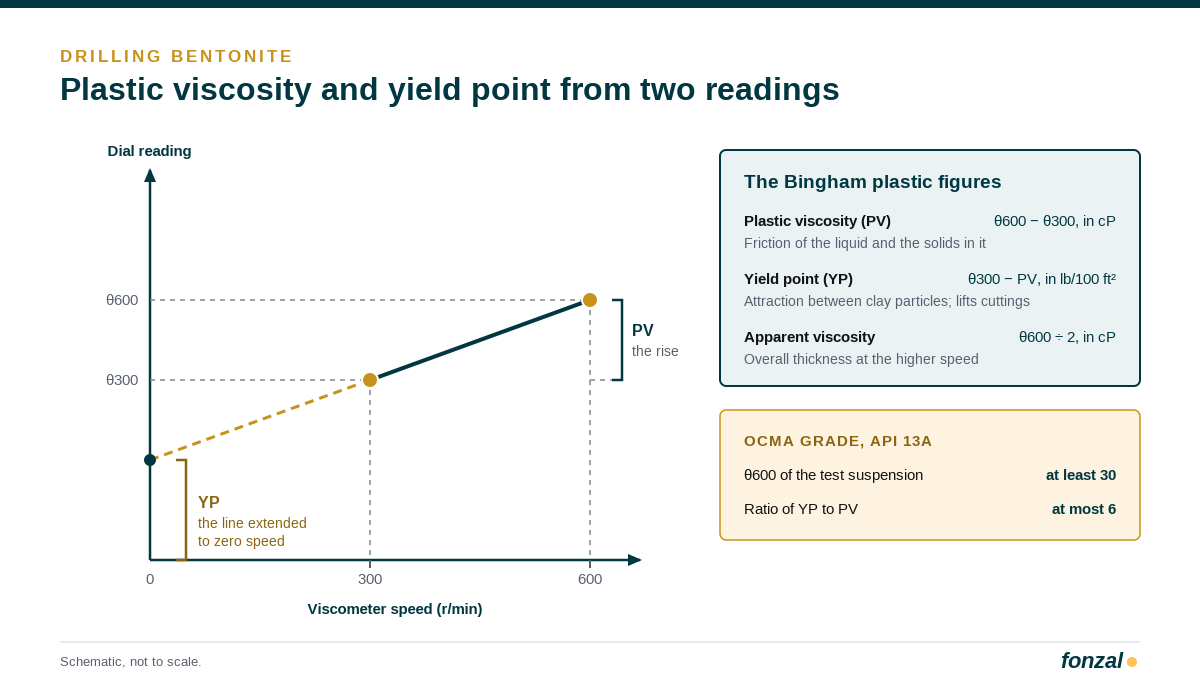
- Plastic viscosity (PV) is the 600 r/min reading minus the 300 r/min reading, in centipoise. It reflects the friction of the liquid and the solids in it. It rises as drilled solids build up, and a low figure helps the rate of drilling.
- Yield point (YP) is the 300 r/min reading minus the plastic viscosity, in lb/100 ft². It reflects the attraction between clay particles, and it is the figure most closely linked to how well the mud lifts cuttings.
- Apparent viscosity is half the 600 r/min reading, in centipoise.
Gel strength is read on the same instrument, at rest for 10 seconds and 10 minutes, and shows how well the mud will hold cuttings when circulation stops.
Filtration and the filter cake
The filtration test shows how the mud seals a permeable wall. In the standard low-pressure API filter press, a sample is held against filter paper of 7.1 in² at 100 psi for 30 minutes. The water that passes through is the filtrate volume, in millilitres, and the cake left on the paper is measured for thickness.
A good bentonite drilling mud leaves a thin cake and a small volume of filtrate. A mud that has picked up drilled solids, or one that has flocculated, leaves a thick, soft cake. A thick filter cake narrows the hole, can trap the drill pipe, and in a water well is harder to remove from the face of the aquifer later.
The API 13A tests for drilling bentonite
API Specification 13A, Drilling Fluids Materials, sets the requirements a drilling bentonite has to meet, tested on a suspension of the clay in water. It defines several bentonite grades. The OCMA grade, formerly OCMA DFCP-4, has these limits:
| Property | OCMA grade limit | What it shows |
|---|---|---|
| Viscometer reading at 600 r/min | At least 30 | The clay builds viscosity at the test concentration |
| Yield point to plastic viscosity ratio | At most 6 | Viscosity comes from the clay, not from additives that only raise the yield point |
| Filtrate volume | At most 16 ml | The clay forms a tight filter cake |
| Residue coarser than 75 µm | At most 2.5% | Little sand or grit that will not swell |
| Moisture | At most 13% | Most of the weight is clay, not water |
The test suspension is prepared and aged under fixed conditions so that results from different laboratories can be compared. The figures describe the powder, not a mud on site, whose properties also depend on the water, the concentration and the ground being drilled.
Tests on the mud during drilling
The field methods are set out in API Recommended Practice 13B-1. The common checks on a water-based bentonite mud are:
| Test | Instrument | What it shows |
|---|---|---|
| Density | Mud balance (fresh water reads 8.34 lb/gal, or 1.00) | How much drilled solids the mud is carrying, and its pressure on the wall |
| Funnel viscosity | Marsh funnel | Changes in thickness from one sample to the next |
| PV, YP and gel strength | Rotational viscometer | Why the mud has thickened or thinned |
| Filtrate and cake | API filter press | How well the mud seals the wall |
| Sand content | Sand content set | Sand that the pit or desander has not removed |
| pH | pH meter or paper | Hard water, cement or acidic ground acting on the clay |
Recording density and funnel viscosity on the drilling log at regular intervals is the simplest way to see a problem coming.
How to mix bentonite drilling mud
Water first. Bentonite hydrates only in fresh water. Salt in the mixing water stops the clay from swelling, and hard water holds it back. Calcium hardness is treated with soda ash before the bentonite is added, the same rule that applies to bentonite support slurry for piling. One field manual for water-well drillers gives a pH of 8 to 9 as the range for full hydration.
Add the powder slowly. Feed the bentonite through a venturi hopper or into a high-shear mixer, a little at a time, so that every particle is wetted. Powder dumped in quickly forms lumps that stay dry inside and never hydrate.
Give it time. The clay keeps swelling after mixing. Circulate the new mud in the pits, bypassing the hole, until it has hydrated, before pumping it down.
Concentration. The US Army Corps of Engineers gives about 50 pounds of bentonite per 100 US gallons of water as a starting point for most drilling, which is roughly 60 kg per cubic metre. Adjust it with trial mixes and the Marsh funnel, because the right figure depends on the clay’s yield, the water and the ground.
Keep it as thin as the hole allows. The same guidance is to hold viscosity as low as possible while still giving the hole stability and fluid-loss control the ground needs.
Bentonite for water well drilling
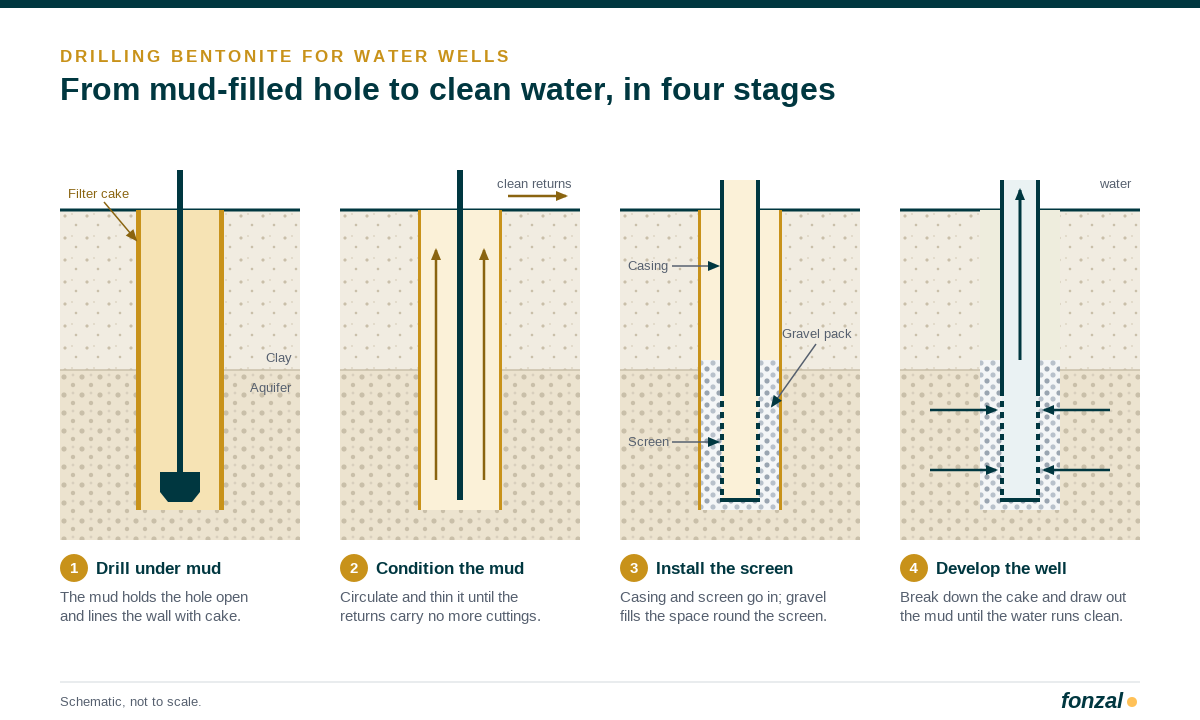
Bentonite for water well drilling has one job that an oil well mud does not: it must come out again. The mud that holds the hole open also plasters the aquifer, the very layer the well is meant to draw from. Every choice about the mud is made with that in mind.
Keep the mud light and thin. The Corps of Engineers gives 32 to 38 seconds on the Marsh funnel as the usual range for a good bentonite mud, and a density usually below 9 lb/gal (about 1.08). Coarser ground needs thicker mud: field manuals for small water wells call for 65 to 75 seconds in gravel. A heavier, thicker mud forms more cake on the aquifer and is harder to remove.
Hold the hole open. Keep the hole full at all times, especially when pulling the pipe, so that the mud column keeps pressing on the wall. In loose sand, a drop in level can let the wall slump.
Let the cuttings settle. A water-well rig usually relies on its mud pits rather than a desander. If the mud is too thick, cuttings do not drop out in the pit and go back down the hole, which raises the density and the cake thickness. Thin with water and dig out the settled cuttings as drilling goes on.
Condition before the screen goes in. At total depth, circulate until the returns are free of cuttings and thin the mud. Casing and screen are then lowered and the gravel pack placed around the screen through a thin, clean fluid.
Develop the well. Development, by surging, jetting or pumping, breaks down the filter cake and draws the mud and fines out of the aquifer and gravel pack until the water runs clean. Bentonite does not break down on its own, so a thick cake or clay pushed deep into the aquifer can permanently reduce the yield of the well. This is the main reason to keep the mud light in the first place.
Common problems with bentonite drilling mud
| Sign | Likely cause | Usual correction |
|---|---|---|
| Mud will not thicken | Salt or hard mixing water, or not enough hydration time | Use fresh water, treat hardness with soda ash, allow time |
| Lumps in the pit | Powder added too quickly | Feed through a hopper or high-shear mixer |
| Density and viscosity creeping up | Drilled solids building up | Settle and dig out the pit, dilute with water, use a desander |
| Cuttings going back down the hole | Mud too thick to drop them in the pit | Thin the mud, slow the flow through the pit |
| Mud level falling | Losses into open gravel or fissures | Thicken the mud; seek specialist advice for large losses |
| Thick, soft filter cake | Drilled solids or flocculated clay | Correct the water and pH, reduce the solids |
Which drilling bentonite to specify
When specifying drilling bentonite, the three properties that matter most are those API 13A tests:
- Viscosity and yield. A high-yield sodium bentonite reaches the working viscosity with less powder.
- Filtrate. A low filtrate volume in the laboratory means a tight, thin filter cake in the hole.
- Fineness and moisture. Coarse residue does not swell and wears pumps. Moisture is weight that is not clay.
Fonzal supplies sodium bentonite powder to API 13A OCMA grade (DFCP-4), suitable for drilling fluids and water-well drilling, in 25 kg bags. It has a minimum yield of 16.5 m³ per ton, sand content below 2.5%, a minimum of 98% passing a 100 mesh screen, maximum moisture of 13% and a pH of 6 to 9. The meaning of the grade is set out in our guide to the OCMA DFCP-4 specification, the clay’s other uses, including earthing backfill and HDD and tunnelling, in the sodium bentonite uses guide, and supply details on the bentonite in the UAE page. A technical data sheet and safety data sheet are available on enquiry.
Standards and further reading
- API Specification 13A, Drilling Fluids Materials (ISO 13500).
- API Recommended Practice 13B-1, Field Testing Water-based Drilling Fluids (ISO 10414-1).
- US Army Corps of Engineers, EM 1110-1-1804, Geotechnical Investigations, Appendix F, on drilling fluids.
- Lifewater International, Drill Manual, Section 5, “Mixing and Using Drill Mud”.
- SLB Energy Glossary: Bingham plastic model, plastic viscosity, yield point and clay yield.
This guide is general information. The mud programme, test methods and acceptance limits for any borehole are those set by its specification and its drilling contractor.
This guide was written with AI assistance from published standards and technical sources, and reviewed by Fermil Muhammed, Technical Engineer at Fonzal.
Need earthing or drilling materials in the UAE or GCC?
Fonzal supplies sodium bentonite, industrial salt, charcoal powder and earthing compound from our Sharjah warehouse, with delivery across the UAE and export throughout the GCC.
Request a QuoteView Products