

A pond built in sand or gravel loses water into the ground beneath it, and a layer of swelling clay is a common way to stop it. This guide to bentonite pond sealing explains how sodium bentonite reduces seepage, the three ways it is applied, how much is needed for a given soil and depth of water, and how the same clay works inside a geosynthetic clay liner. It ends with the conditions that weaken a bentonite seal, and how to avoid them.
Why ponds leak
Water leaves a pond through the open pores of its floor and banks. Clean sand and gravel have large, connected pores and little or no clay to block them, so water drains through them freely. Fractured rock behaves in the same way. A pond dug in such ground needs a lining of some kind, either a layer of low-permeability soil or a manufactured liner.
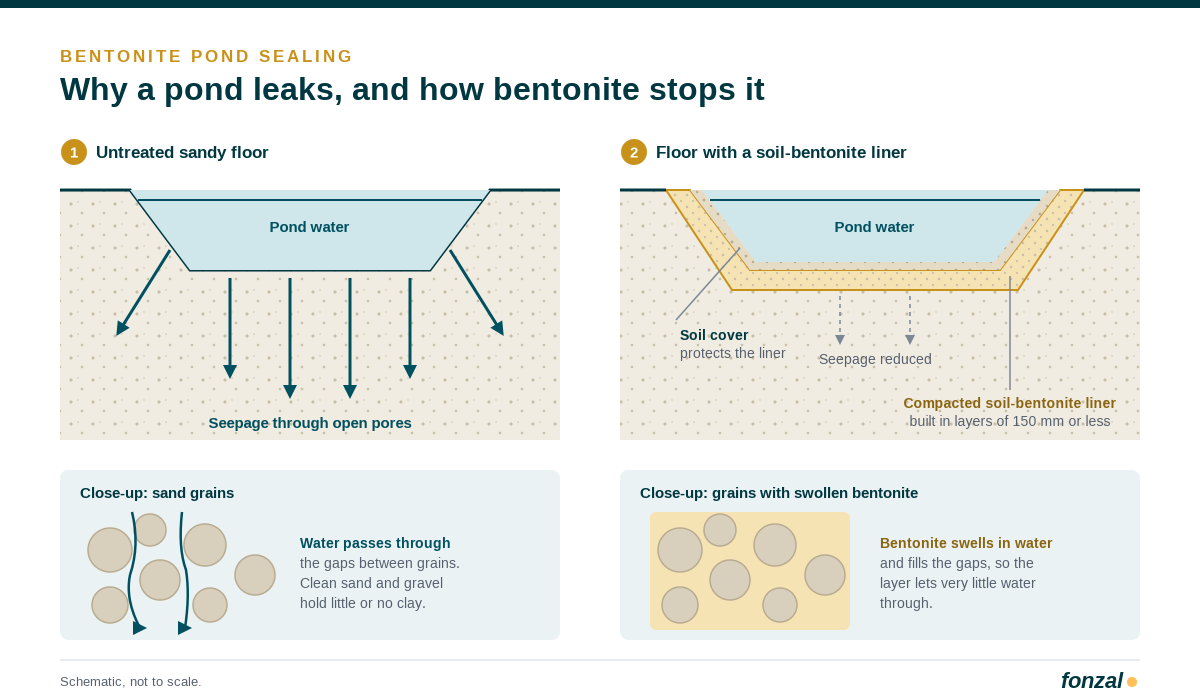
How does bentonite seal a pond?
Sodium bentonite is a clay that swells to many times its dry volume when it takes up water. Mixed into a porous soil, or spread as a layer over it, the swollen clay fills the gaps between the grains and turns an open soil into a layer of very low permeability.
The figures show how large the change is. In laboratory tests reported by the US Environmental Protection Agency, dry, unconfined bentonite has a hydraulic conductivity of about 1 × 10⁻⁶ cm/s. Once saturated, it typically drops below 1 × 10⁻⁹ cm/s, a thousand times lower. The same swelling lets a hydrated bentonite layer close small holes: in laboratory tests, a hole up to 75 mm across in a bentonite liner sealed itself.
The type of clay matters, which is why sodium bentonite for pond sealing is specified. University of Missouri Extension guidance, written with the US Natural Resources Conservation Service (NRCS), notes that calcium bentonite swells very little and states that only sodium bentonite should be used for pond or reservoir sealing. This is the same property that lets bentonite build a thin, tight filter cake in a pile bore and hold moisture around an earth electrode.
Which soils bentonite pond sealing suits
Bentonite works best where the soil already has some fine particles for the clay to bind. The Missouri guidance gives the best results on soils with less than 50% fines and a plasticity index below 15. The NRCS Arizona standard for bentonite treatment (code 521C) lists silts, silty and clayey sands and silty and clayey gravels (Unified classes ML, SM, SC, GM and GC) as soils that bentonite can seal effectively. Clean, poorly graded sands and gravels and fractured rock may need a fine-grained soil brought to site and mixed with the bentonite to make the sealing layer.
How to seal a pond with bentonite
There are three main ways to apply the clay. The first two need the pond drained and the floor dry; the third is used when the pond cannot be emptied.
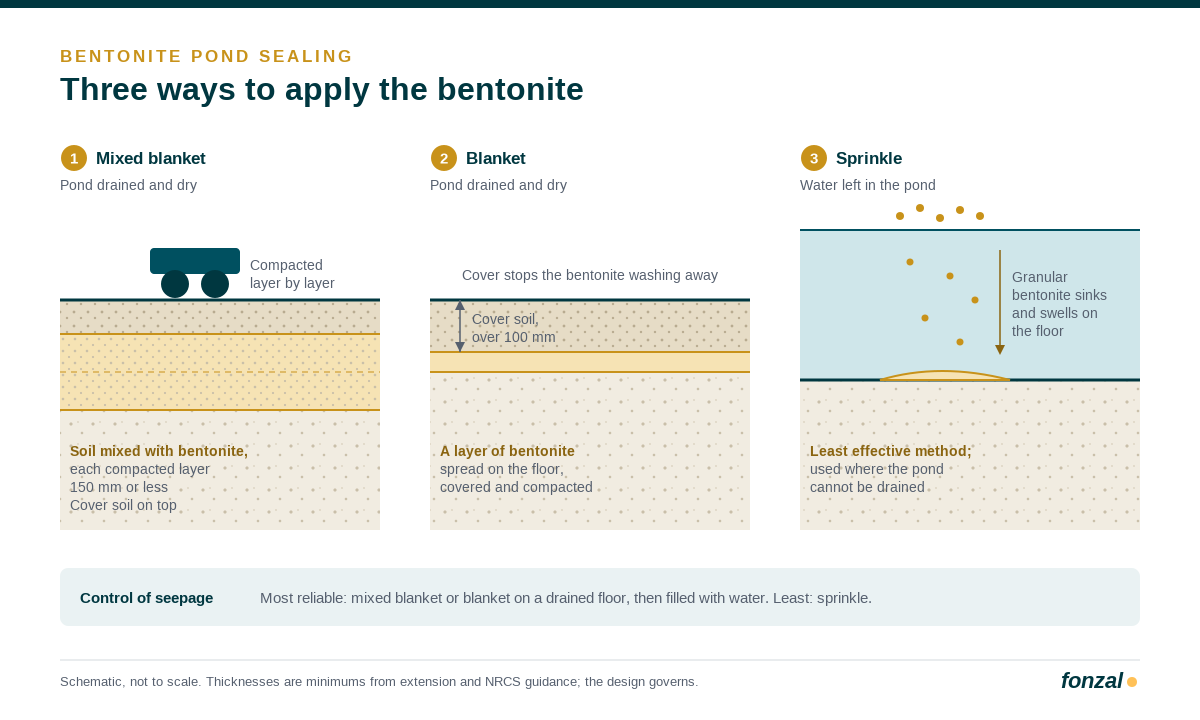
- Mixed blanket. The bentonite is spread on the dry floor and mixed into the top layer of soil with a disc harrow, then compacted. The NRCS Arizona standard requires each compacted layer to be no more than 150 mm (6 in) thick and compacted before the next is placed, and a finished liner at least 150 mm thick. The soil should be moist enough when it is compacted that it forms a firm ball when squeezed. Fine powdered bentonite is preferred for spreading and mixing into soil.
- Blanket. A layer of bentonite is spread over the floor and covered with soil, which protects it and holds it in place. Texas A&M AgriLife Extension describes this as generally more effective than the sprinkle method when it is done correctly, with a cover more than 100 mm (4 in) thick.
- Sprinkle. Granular bentonite is scattered over the water surface, from the bank or a boat, and sinks to the floor, where it swells over the leaking area. It is the least effective of the three methods. The Missouri guidance recommends coarse, granular bentonite only where the zone of leakage is known, for example where a whirlpool shows where the water is escaping, and advises against spreading fine bentonite on the water.
Whichever method is used, the NRCS standard advises filling the pond with water soon after the work is finished, so that the new liner does not dry out and crack.
How much bentonite does a pond need?
The amount depends on the soil and the depth of water, and is best set by a laboratory permeability test on the site soil with the bentonite that will be used. Without tests, published guidance gives these starting rates.
Extension rates. Texas A&M AgriLife Extension puts the usual rate at 1 to 2 lb per ft² of floor, about 5 to 10 kg/m². It gives 0.5 lb per ft² (about 2.4 kg/m²) for a floor of fine sand or sandy loam under less than 1.8 m (6 ft) of water, and 1 lb per ft² (about 4.9 kg/m²) for the same soil under 1.8 to 6 m (6 to 20 ft). The Missouri guidance gives 1 lb per ft² (about 4.9 kg/m²) for soil with some clay up to 3 lb per ft² (about 14.6 kg/m²) for sand and gravel, for each 100 mm (4 in) lift.
NRCS rates per thickness of liner. The NRCS Arizona standard sets the minimum rate of finely ground bentonite for each 25 mm (1 in) of compacted liner:
| Soil (Unified class) | lb per ft² per inch of liner | kg/m² per 25 mm of liner (converted) |
|---|---|---|
| Clays (CL) | 0.345 to 0.380 | 1.7 to 1.9 |
| Silts (ML, CL-ML) | 0.375 to 0.385 | 1.8 to 1.9 |
| Clayey sands (SC) | 0.420 to 0.430 | 2.1 |
| Silty sands (SM, SC-SM, SP-SM) | 0.500 to 0.515 | 2.4 to 2.5 |
| Clean sands (SP, SW) | 0.625 to 0.640 | 3.1 |
| Gravels and fractured rock (GW, GP) | 0.675 to 0.700 | 3.3 to 3.4 |
The same standard makes the liner thicker as the water gets deeper, because the pressure on the floor rises with depth:
| Water depth | Minimum liner thickness |
|---|---|
| Up to 2.4 m (8 ft) | 150 mm (6 in) |
| 2.5 to 4.9 m (8 to 16 ft) | 300 mm (12 in) |
| 4.9 to 7.3 m (16 to 24 ft) | 450 mm (18 in) |
| 7.3 to 9.1 m (24 to 30 ft) | 600 mm (24 in) |
Above about 7.3 m (24 ft) of water, the standard suggests considering a flexible membrane liner instead.
A worked example. A pond floor of 1,000 m² in silty sand holds 2 m of water. The table gives a liner 150 mm thick, which is six 25 mm increments. At 2.4 to 2.5 kg/m² per increment, the floor needs about 14.6 to 15.1 kg of bentonite per m², or about 14.6 to 15.1 tonnes for the whole floor, before any allowance for the banks.
Geosynthetic clay liners
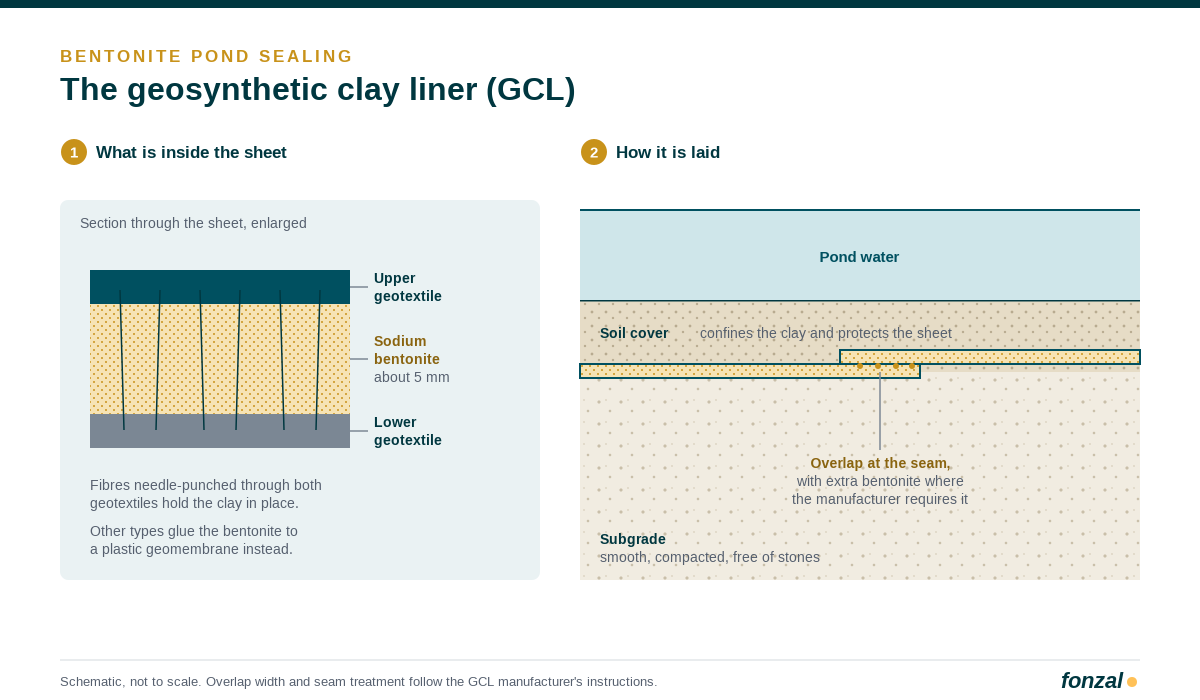
A geosynthetic clay liner (GCL) is a factory-made bentonite pond liner. A thin layer of sodium bentonite, about 5 mm, is held between two geotextiles by needle-punched fibres or stitching, or glued to a plastic geomembrane. The sheets arrive in rolls, are laid over the prepared floor with the edges overlapped, and are covered with soil.
The EPA notes that manufacturers typically use about 1 lb of bentonite per ft² (about 4.9 kg/m²) and that the performance of a GCL depends mainly on the quality of the clay, the amount per unit area and how evenly it is spread. The tests used to control the bentonite and the finished sheet are ASTM standards:
| Test | ASTM method | What it shows |
|---|---|---|
| Swell index | D5890 | How far 2 g of the clay swells in water |
| Fluid loss | D5891 | How well the clay forms a low-permeability cake |
| Mass per unit area | D5993 | How much bentonite the sheet holds |
| Index flux | D5887 | How much water passes through a saturated sample |
The swell index matters for site-mixed liners too: the NRCS Arizona standard requires a sodium bentonite with a free swell of at least 22 mL by ASTM D5890, unless laboratory tests are used for the design.
Installation points. The subgrade should be smooth, compacted and free of stones. The GCL must be kept dry until it is covered: bentonite that hydrates without a load on it swells freely and can push the geotextiles apart. Once the soil cover is in place, the clay draws moisture from the soil and hydrates under confinement. The width of the overlaps, and whether extra bentonite is placed in them, follow the manufacturer’s instructions for the product.
What reduces a bentonite seal?
A bentonite seal is only as good as the swelling of the clay, and anything that stops it swelling or opens cracks in it lets water through.
- Calcium bentonite. It swells far less than sodium bentonite and is not suitable for sealing.
- Drying. Bentonite shrinks and cracks when it dries. University of Florida guidance advises against bentonite where the water level falls a long way and exposes the floor. The NRCS standard calls for protection against desiccation cracking and water-level fluctuation, and for at least 150 mm of soil cover over the liner of a waste impoundment.
- Calcium and magnesium in the water. Over time, calcium and magnesium in the soil or water can replace the sodium in the clay. In a study of GCLs dug up from landfill covers, Meer and Benson (2007) found that this exchange had happened in every sample, and that drying and re-wetting such liners raised their hydraulic conductivity by 1.5 to 4 orders of magnitude.
- Salt water. Salt holds back the swelling of bentonite, as it does in a bentonite slurry mixed with salty water. Laboratory tests on GCLs show the permeability rising as the salt concentration rises, and liners hydrated first with fresh water perform better than those wetted directly by the salty liquid. Ponds that will hold brackish or salty water need tests with that water.
- Physical damage. Wave action, inflow pipes, livestock and burrowing animals can erode or puncture the layer. Thicker liners are used where waves act on the floor, and the liner is protected where pipes discharge onto it.
Bentonite waterproofing below ground
The same swelling is used for bentonite waterproofing on buildings. Bentonite panels and sheets of the GCL type are placed against basement walls and slabs, and bentonite strips are set in construction joints in concrete as waterstops. The principles are those of a pond liner: the bentonite must be confined, so that it swells into a dense seal rather than expanding freely, and its performance depends on the water it meets. Groundwater that is salty or contaminated can reduce the swelling, so the product chosen should be tested against it. The clay’s other uses are described in our sodium bentonite uses guide.
Which bentonite to specify
For bentonite pond sealing, choose sodium bentonite, never calcium, and check these properties on the data sheet:
- Swelling. The free swell by ASTM D5890 is the most direct measure of sealing power. The NRCS standard sets a minimum of 22 mL.
- Form. Fine powder for the mixed blanket and blanket methods, where it is spread and mixed into the soil; coarse granules for the sprinkle method, where it has to sink through water before it swells.
- Fineness and grit. Sand and coarse residue do not swell and add nothing to the seal.
The OCMA grade is a drilling specification, so it does not set a swell figure; what it does require is set out in our guide to the OCMA DFCP-4 specification.
Fonzal supplies sodium bentonite powder to API 13A OCMA grade (DFCP-4), suitable for pond sealing and civil engineering, in 25 kg bags. It has sand content below 2.5%, a minimum of 98% passing a 100 mesh screen, maximum moisture of 13% and a pH of 6 to 9. As a powder, it suits the mixed blanket and blanket methods; the same powder is used for drilling mud and for HDD and tunnelling. Supply details are on the bentonite in the UAE page. A technical data sheet and safety data sheet are available on enquiry.
Standards and further reading
- USDA Natural Resources Conservation Service, Arizona, Conservation Practice Standard 521C, Pond Sealing or Lining: Bentonite Treatment (2010).
- University of Missouri Extension, G1555, Sealing Ponds, with the Natural Resources Conservation Service.
- Texas A&M AgriLife Extension, Sealing Ponds and Lakes with Bentonite (2022).
- University of Florida IFAS Extension, WI012, Selecting a Method for Sealing Ponds in Florida.
- US Environmental Protection Agency, EPA530-F-97-002, Geosynthetic Clay Liners Used in Municipal Solid Waste Landfills (revised 2001).
- ASTM D5887, D5890, D5891 and D5993, test methods for geosynthetic clay liners.
- Meer, S. R. and Benson, C. H. (2007), “Hydraulic conductivity of geosynthetic clay liners exhumed from landfill final covers”, Journal of Geotechnical and Geoenvironmental Engineering, 133(5).
- Petrov, R. J. and Rowe, R. K. (1997), “Geosynthetic clay liner (GCL): chemical compatibility by hydraulic conductivity testing and factors impacting its performance”, Canadian Geotechnical Journal, 34.
This guide is general information. The liner design, application rate and acceptance tests for any pond or structure are those set by its specification and its designer.
This guide was written with AI assistance from published standards and technical sources, and reviewed by Fermil Muhammed, Technical Engineer at Fonzal.
Need earthing or drilling materials in the UAE or GCC?
Fonzal supplies sodium bentonite, industrial salt, charcoal powder and earthing compound from our Sharjah warehouse, with delivery across the UAE and export throughout the GCC.
Request a QuoteView Products